
Chart 10-2 · the rooms · 12 min
Orifice, fundus, pylorus
A read of this page, with the plate.
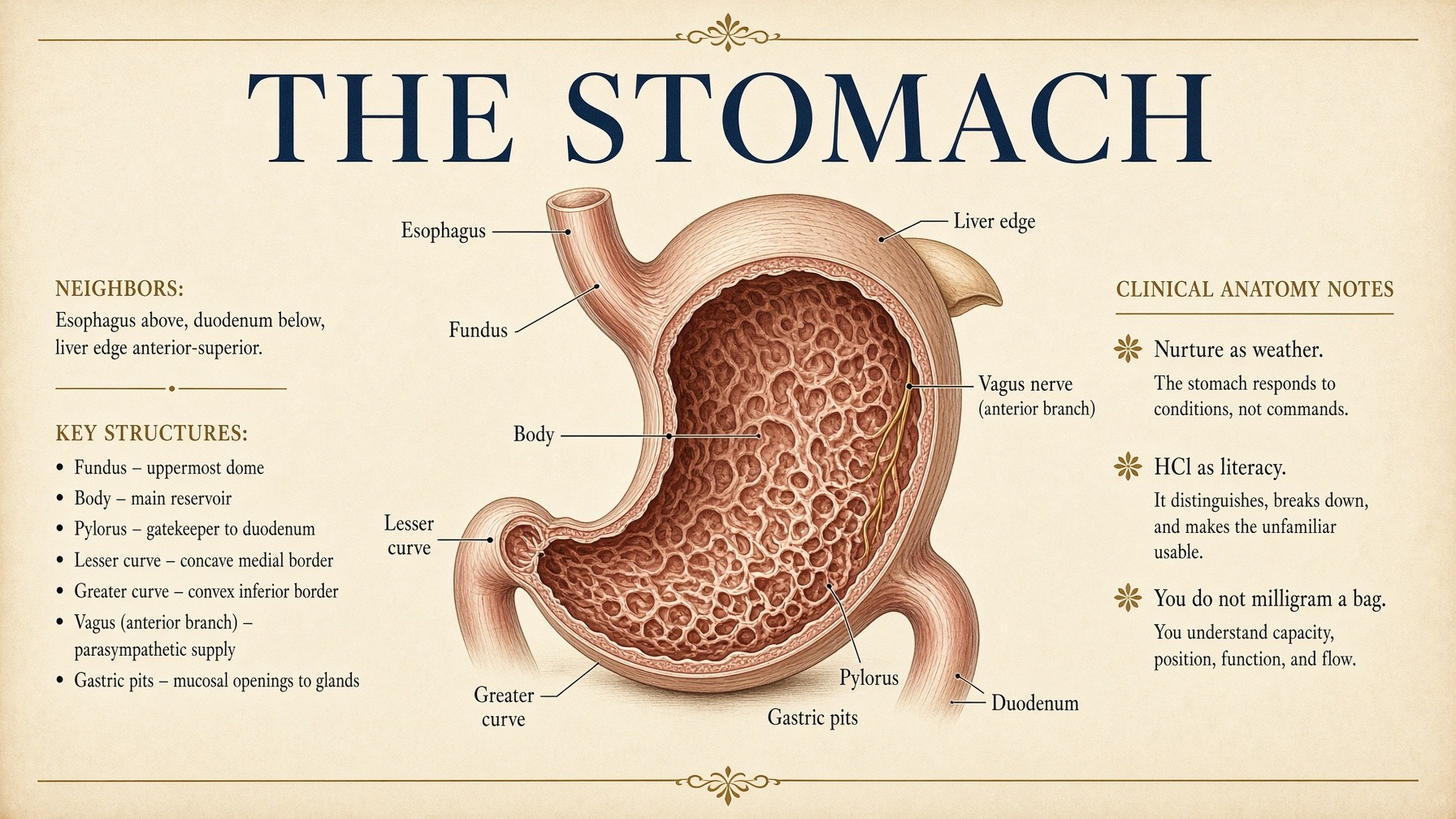
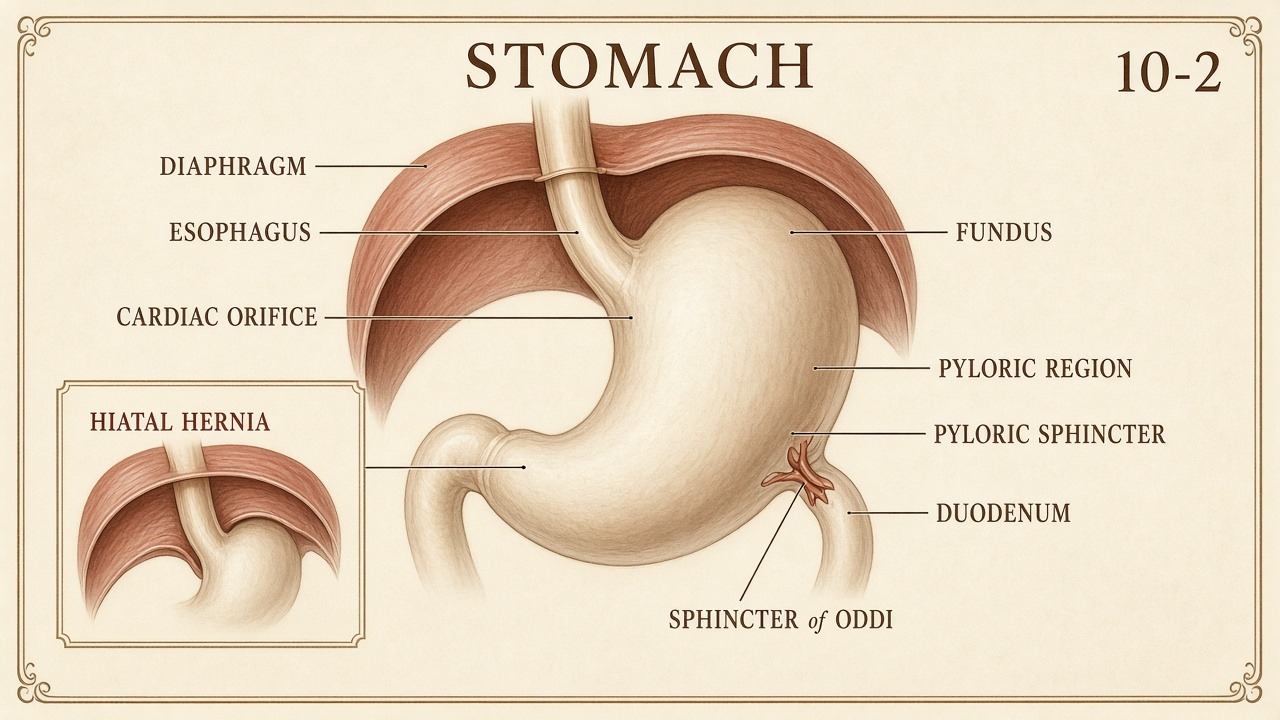
Esophagus passes the diaphragm and enters at the cardiac orifice. That orifice holds a light contraction. It is not really a valve. Ordinarily it keeps food from backing up. Fundus is the top: less acid, less pepsin; salivary amylase can still work a little here. Pyloric region is the main bag, where more acid lives. Pyloric sphincter is the door to the duodenum. The duodenum decides that door — open or close — by the pH it perceives, and by whether it is already stretched.
When the bag slides
Hiatal hernia: cardiac orifice and the top of the bag above the diaphragm. Reflux can follow. The drawing teaches the geometry so you can name the rooms. Ask whether the bag is sitting where the drawing says. Feeling, presenting age, meridians.
Her voice, from the class.
Orifice, fundus, pylorus — the rooms
Practice
Swallow once. Notice the pause at the diaphragm, then the bag. Journal whether the aftertaste rose or went down. Feeling first, then the room.
Check
This hour teaches that the cardiac orifice is:
- The sphincter of Oddi, where bile and pancreatic juice empty
- A light contraction that ordinarily keeps food from backing up — not a valve ✓
- The pyloric sphincter, decided by the fundus
Chart 10-2. Light contraction. Not Oddi, not pylorus.
You use the pyloric door by:
- Asking the liver whether bile is soap
- Asking the duodenum — pH and stretch decide open or close — then Chart 1-1 if the door is a feeling ✓
- Parking the fundus on lung because it is less acid
Downstream decides. Bicarbonate is the later ask. Feeling, age, meridians.
A true line on this hour:
- Skip permission and invent the next board
- That orifice holds a light contraction. ✓
- Opening a chakra by squeezing it
That orifice holds a light contraction.
This hour teaches that:
- Collapse the map into one medical stamp
- Ordinarily it keeps food from backing up. ✓
- A swap of clothes for the organ
Ordinarily it keeps food from backing up.
Orifice, fundus, pylorus — keep this:
- A name that captures the whole sky
- Fundus is the top: less acid, less pepsin; salivary amylase can still work a little here. ✓
- A cream you prescribe from the chart
Fundus is the top: less acid, less pepsin; salivary amylase can still work a little here.
Practice on this hour is to:
- A rigid medical diagnosis you must stamp
- Notice the pause at the diaphragm, then the bag. ✓
- Inventing a colorful story so the session feels complete
Method before bottle. Trace what the lesson names.
Chart 10-2 on this hour is used as:
- Treating every hour as interchangeable production
- Cardiac orifice is a light contraction, not a true valve. Hiatal hernia as geometry… ✓
- Proof of supernatural status
Translator map — Chart 10-2. Not a prescription pad.
The lab on this hour is for:
- A graded exam that invents the next curriculum
- Feeling and naming what the lesson maps — journal, not a bottle ✓
- A prescription pad for the lab name
Lab is literacy. Not a dose from the yield.
"Orifice, fundus, pylorus" here is best treated as:
- A tourist collection of special experiences
- Esophagus passes the diaphragm and enters at the cardiac orifice. ✓
- A rigid diagnosis tool that replaces sleep
Train with the map. Do not invent a second sky.
Keep this from the body of the hour:
- Invent a colorful story so the session feels complete
- Pyloric region is the main bag, where more acid lives. ✓
- A board you invent without her permission
Pyloric region is the main bag, where more acid lives.