
Chart 1-6 · 12 min
The mid-back stack
A read of this page, with the plate.
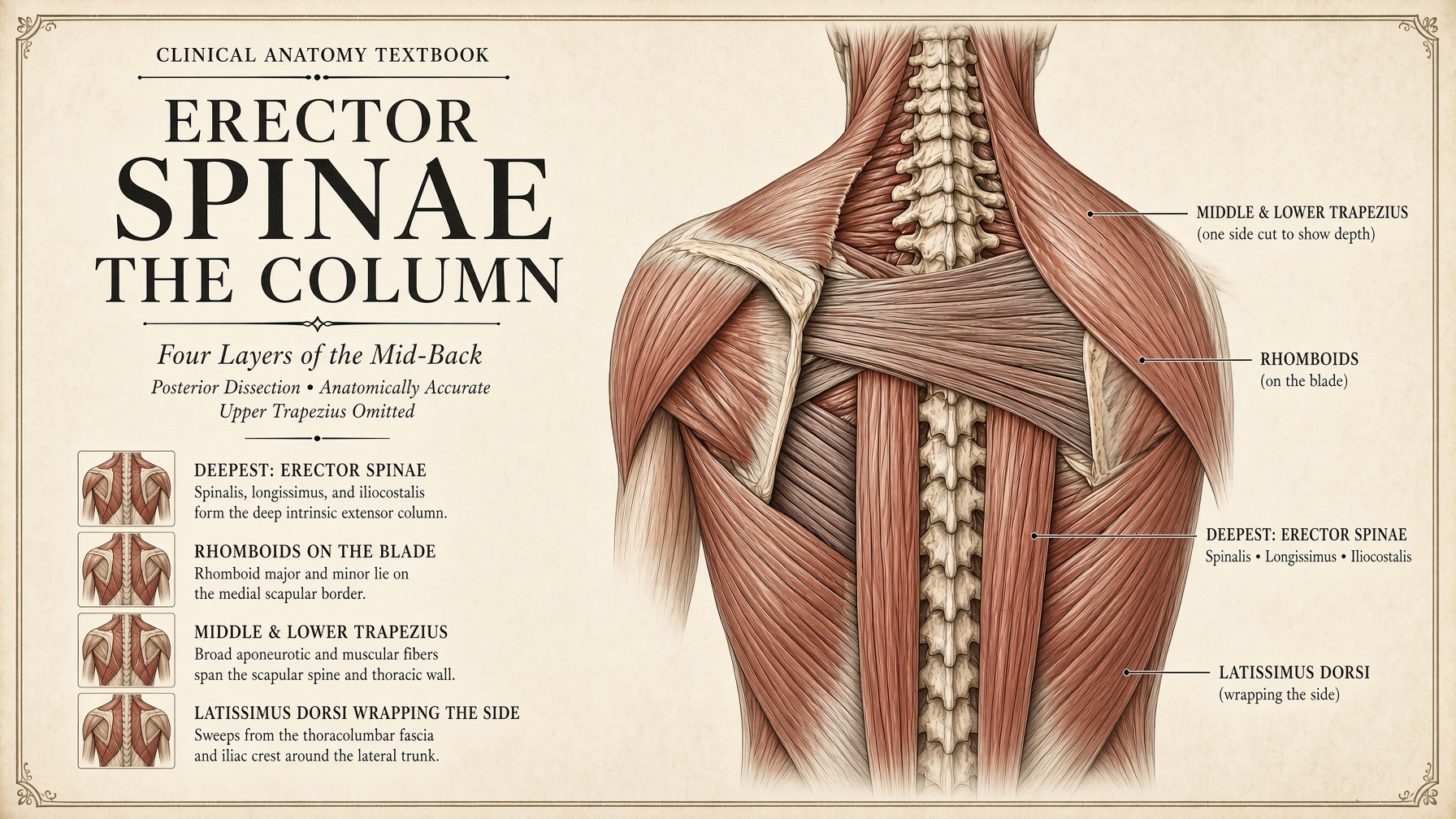
Kapel’s chart 1-6 is a pile of sheets, not a jumble. Deep along the spine: sacrospinalis, the erectors. On the blade: rhomboids. Over them: middle and lower trapezius. The wide wrap: latissimus. On the rib wall, holding the blade from the front: serratus anterior. The handwritten card also names intercostals. They are not in the typed pages of this class. They stay held.
Why Class 1 started here
Spleen, liver, and bladder already had a door on this wall. Course 02 does not abandon that door. It names the neighbors so ‘mid-back’ is not one muscle with three opinions.
How to look
Back view for erectors, rhomboids, trapezius, latissimus. A side-front view for serratus — it is a rib muscle that the back complains about. If a student only ever looks from behind, they will name a rhomboid for a serratus job.
Practice
On the map, climb the stack from erector to latissimus. Name who belongs on whom. Serratus last, from the front.
Check
Serratus anterior is best pictured from:
- The rib wall — it holds the scapula from the front and sides ✓
- Only the back, because all mid-back muscles live there
- The iliac fossa, with psoas
It is a chest-wall muscle. The back will name the wrong fiber if you never turn the person.
You use the stack by:
- Climbing erector, rhomboid, trapezius, latissimus, then serratus from the front — each with its own door ✓
- Treating mid-back as one bladder muscle because the paraspinals are deepest
- Parking serratus on kidney with psoas, because both are on the front
Five fibers, five addresses. Bladder is the column. Kidney is iliopsoas, later.
They on this board are:
- A bottle that finishes the feeling
- Not in the typed pages of this class ✓
- A replacement for the physician
They — Not in the typed pages of this class
This hour teaches that:
- Inventing a colorful story so the session feels complete
- Kapel's chart 1-6 is a pile of sheets, not a jumble. ✓
- Skip permission and invent the next board
Kapel's chart 1-6 is a pile of sheets, not a jumble.
The mid-back stack — keep this:
- A name that captures the whole sky
- They are not in the typed pages of this class. ✓
- Write a dose so the feeling looks finished
They are not in the typed pages of this class.
A true line on this hour:
- Living against the tide on purpose
- A side-front view for serratus — it is a rib muscle that the back complains about. ✓
- Collapsing two houses into one word
A side-front view for serratus — it is a rib muscle that the back complains about.
Practice on this hour is to:
- A tourist empty-mind contest
- On the map, climb the stack from erector to latissimus. ✓
- Skip the journal and invent a diagnosis
Method before bottle. Trace what the lesson names.
Chart 1-6 on this hour is used as:
- A dose you write from a yield
- Chart 1-6 as a pile of sheets. Banner: five layers, deep to superficial — erector… ✓
- Thyroxine from the medulla
Translator map — Chart 1-6. Not a prescription pad.
The lab on this hour is for:
- A graded exam that invents the next curriculum
- Feeling and naming what the lesson maps — journal, not a bottle ✓
- A prescription pad for the lab name
Lab is literacy. Not a dose from the yield.
A common mistake this hour corrects:
- Squeezing the gate until it 'opens'
- Course 02 does not abandon that door. ✓
- A reason to skip permission
Course 02 does not abandon that door.