
Orientation · 10 min
Muscle meets meridian
A read of this page, with the plate.
A muscle is tissue. A meridian is an address. Course 02 is the place they sit at the same table — muscle as translator, meridian as address.
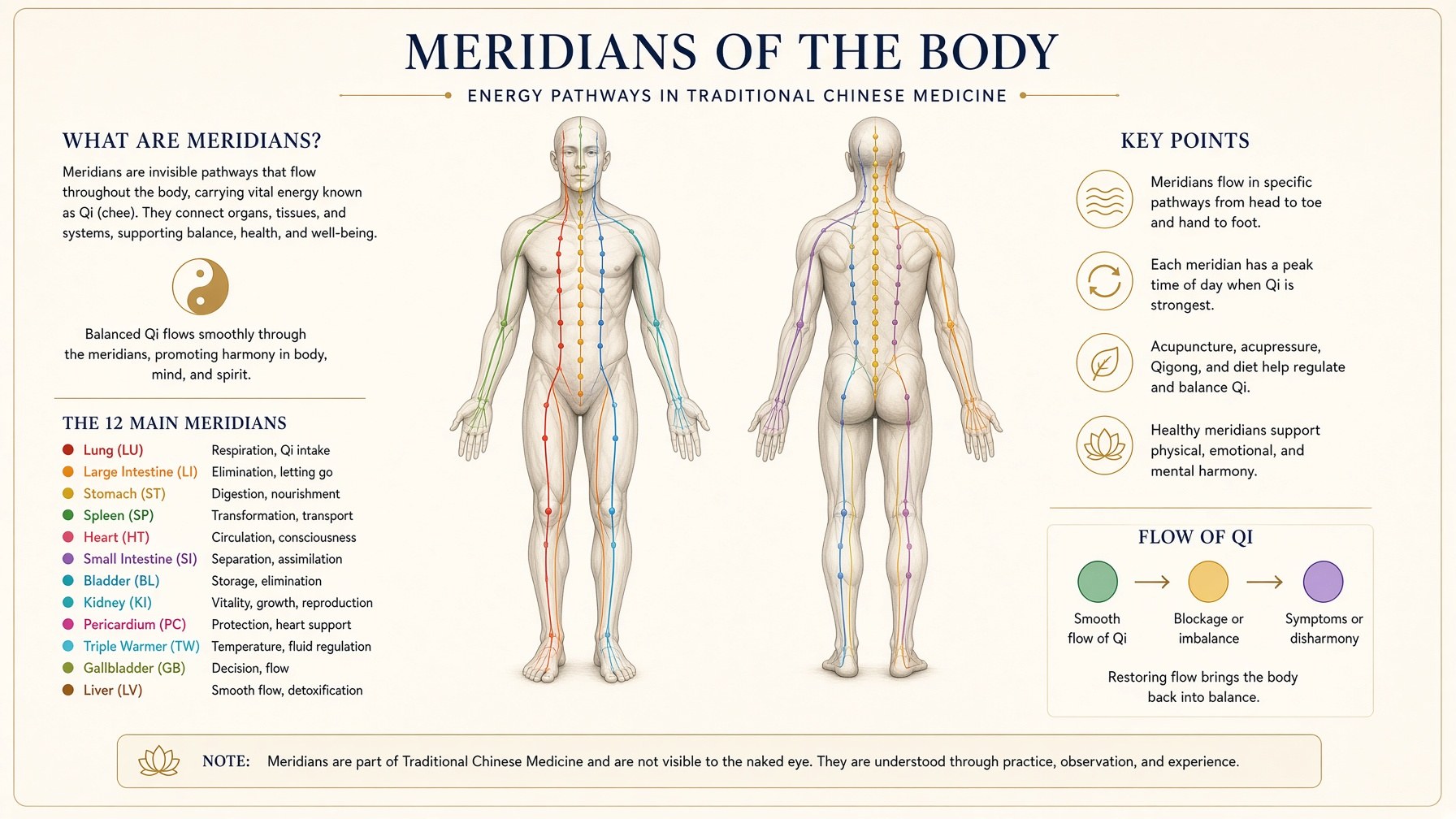
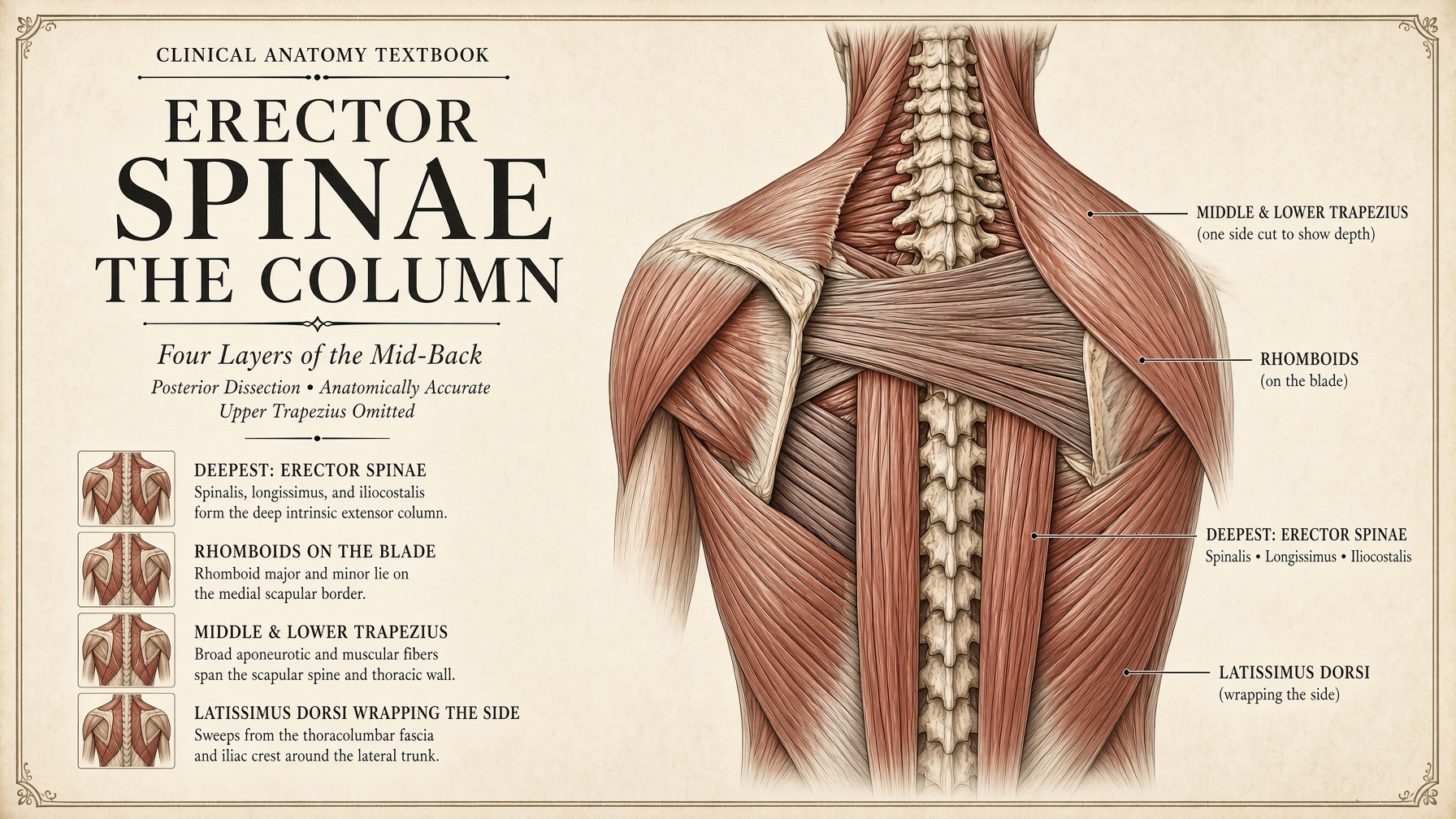
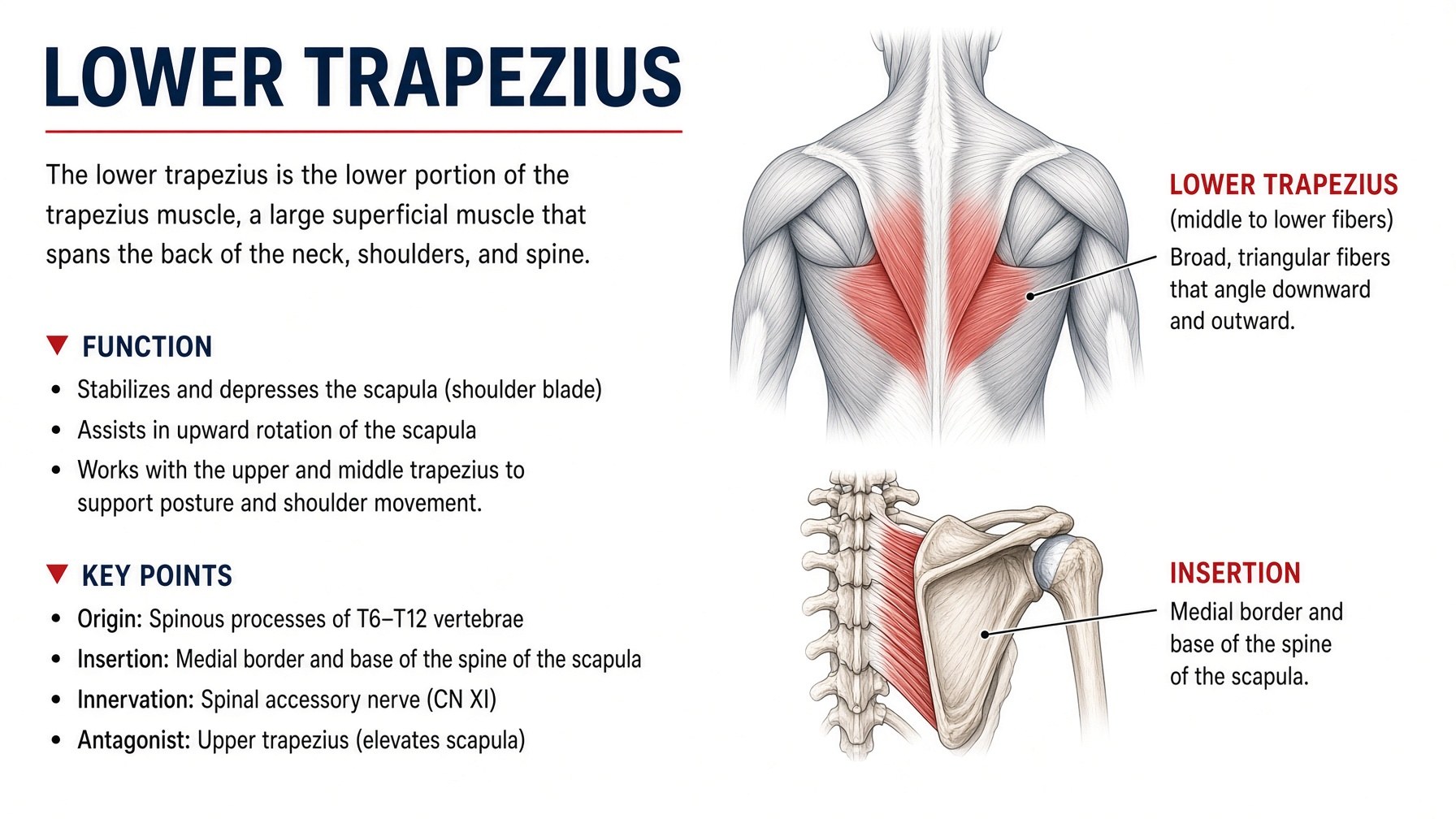
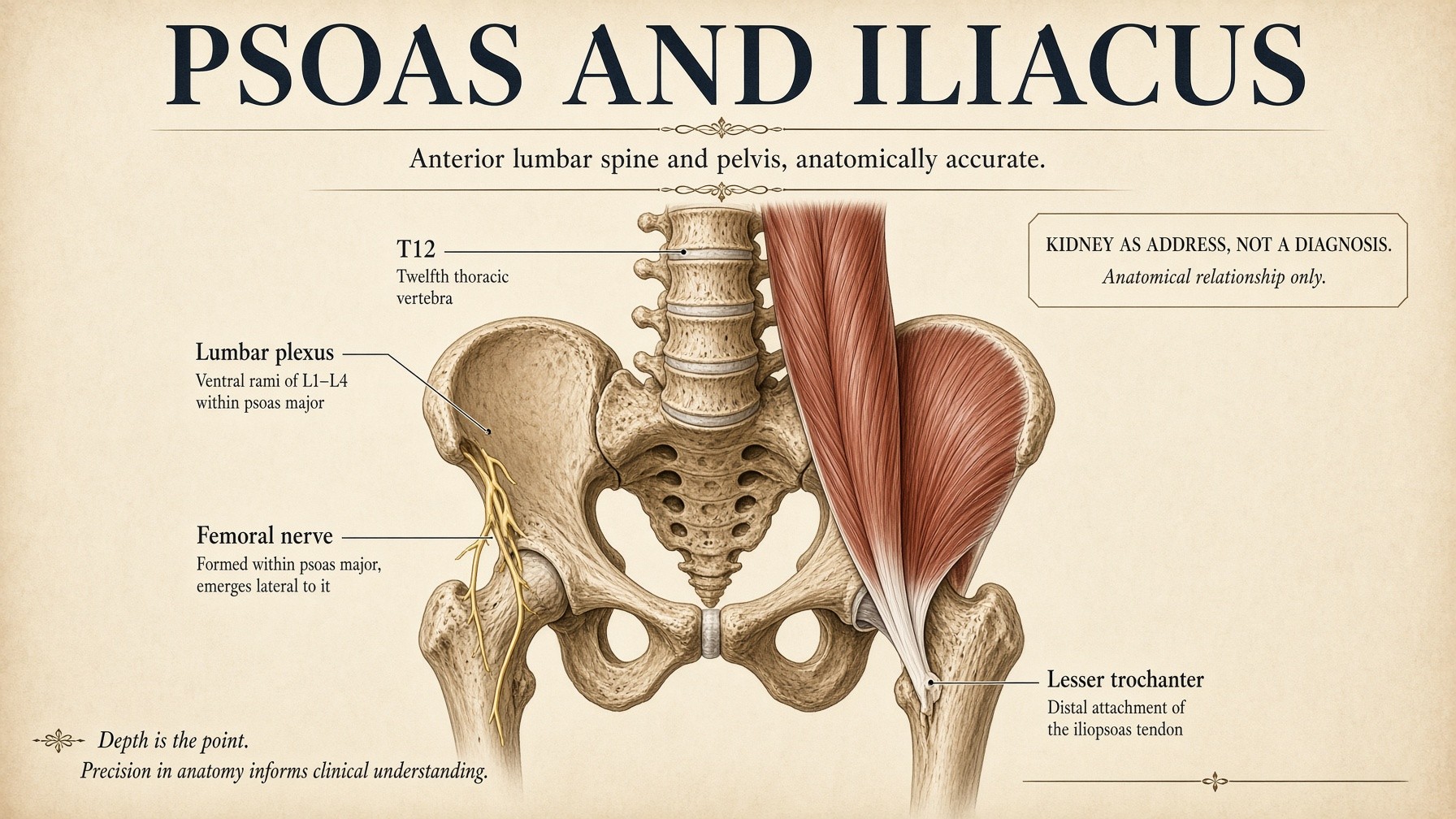
Course 01 taught Chart 1-1: feeling, belief, and intention coalesce, slow, enter sequential time, then tissue. Meridians are the last step of that cascade — they translate mental and emotional directives into the cell. Class 1 used the mid-back because three channels already speak there — spleen on the mid-trapezius, liver on the rhomboids, bladder on the paraspinals. Class 2, Kapel’s room, widens the table: the rest of the mid-back, the low back, the belly wall, and a sequence of questions she wrote as Spinal Alignment 2-1.
What ‘governed by’ means here
In this lineage a muscle is asked as a translator for a channel. That is applied kinesiology as Kapel used it, sitting next to Chinese medicine as a second map, and next to ordinary anatomy as the tissue you can name. Origin, insertion, action, and nerve are how you respect depth. The meridian is the address. Chart 1-1 still orders the work — feeling, presenting age, then meridians.
What this course is for
The mid-back stack and the low-back cylinder, each fiber named. The fiber under the tendon. Chart 2-1 as a sequence of questions. Influence of the material on Chart 1-1. Permission first. Then the map. Then the material.
Her voice, from the class.
Why muscles + meridians
Always connect structure to a meridian
Practice
Open the muscle map. Touch one mid-back and one low-back muscle. Say out loud: the name, origin, insertion, action, the meridian as address.
Check
In this course, a muscle is:
- A translator for a channel — origin, insertion, action named, meridian as address ✓
- The same thing as a meridian, so the names can swap
- A bladder fiber whenever it stands beside the spine, so erectors and rhomboids share a door
Translator, not a swap of clothes. Anatomy stays anatomy. The meridian is the address.
You use Course 02 by:
- Asking permission, then naming the fiber and the door, then Chart 1-1 — feeling, presenting age, meridians ✓
- Parking every mid-back fiber on bladder because they all sit beside the spine
- Collapsing muscle into meridian so the hour has one word
Permission, translator, address. Chart 1-1 still orders the work. Bladder is the erectors’ door, not the whole wall.
Meridians on this board are:
- A tourist empty-mind contest
- The last step of that cascade — they translate mental and emotional directives into… ✓
- Opening a chakra by squeezing it
Meridians — The last step of that cascade — they translate mental and emotional…
Muscle meets meridian — keep this:
- Treating every hour as interchangeable production
- Meridians are the last step of that cascade — they translate mental and emotional… ✓
- Collapsing two houses into one word
Meridians are the last step of that cascade — they translate mental and emotional directives into the cell.
This hour teaches that:
- A rigid medical diagnosis you must stamp
- In this lineage a muscle is asked as a translator for a channel. ✓
- A bottle that finishes the feeling
In this lineage a muscle is asked as a translator for a channel.
A true line on this hour:
- Thyroxine from the medulla
- Pericardium is circulation–sex — one door. ✓
- A reason to skip permission
Pericardium is circulation–sex — one door.
Practice on this hour is to:
- Living against the tide on purpose
- Open the muscle map. ✓
- A name that captures the whole sky
Method before bottle. Trace what the lesson names.
Chart 1-1 on this hour is used as:
- A cream you prescribe from the chart
- A translator map — Chart 1-1 — not a prescription pad ✓
- A diagnosis stamp you must write today
Translator map — Chart 1-1. Not a prescription pad.
Permission on this hour means:
- Skip permission if the chart looks clear
- Ask whether you are all alone in the auric field — leave physician charts to physicians ✓
- Write the taper yourself from the yield
Permission first. Anatomy as translator, not a swap of clothes.
The lab on this hour is for:
- A graded exam that invents the next curriculum
- Feeling and naming what the lesson maps — journal, not a bottle ✓
- A prescription pad for the lab name
Lab is literacy. Not a dose from the yield.