
Instrument · 9 min
Breath as the handle
A read of this page, with the plate.
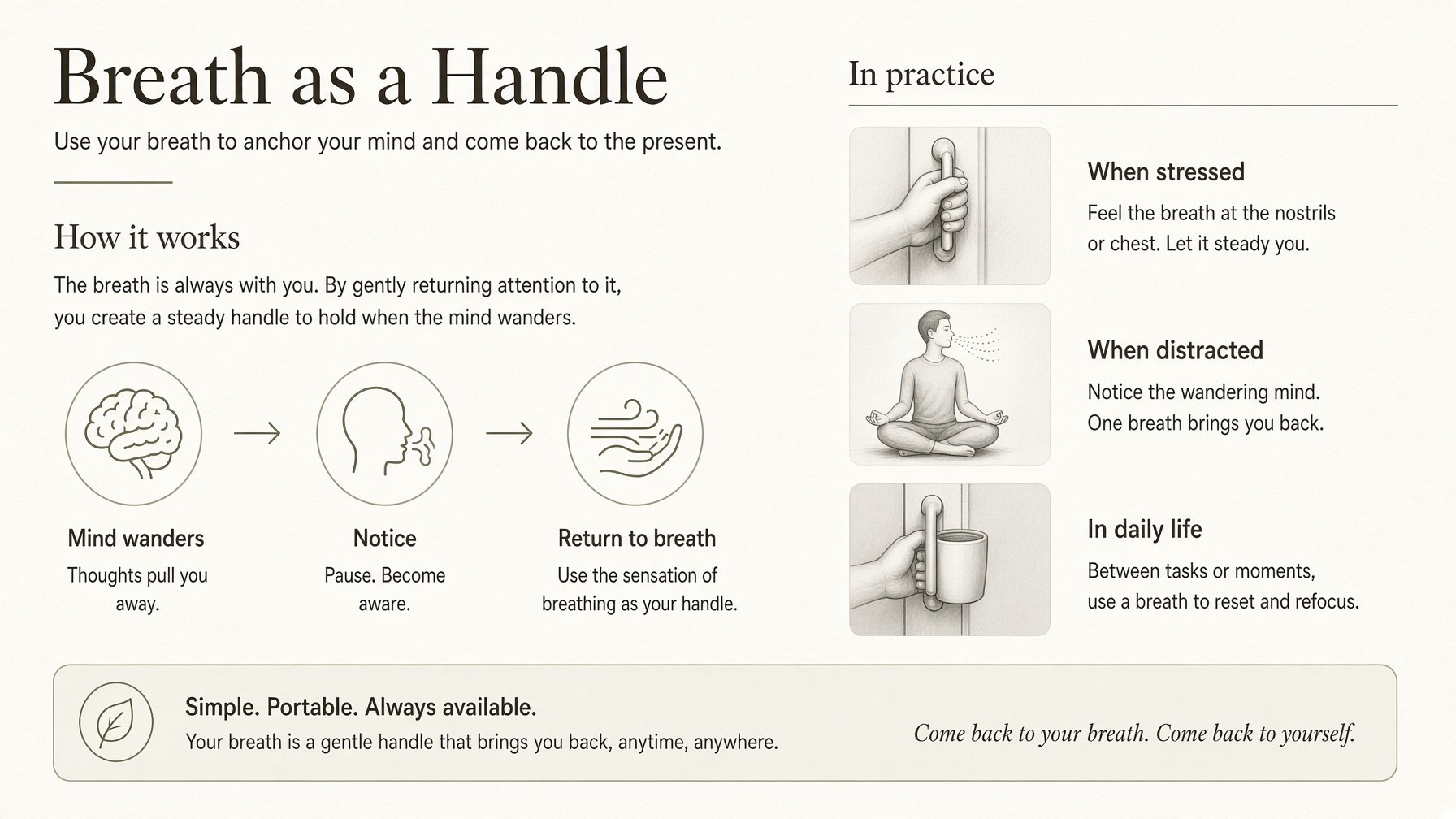
If prana is difficult to describe, breath is not. Breath is the handle on the field: the one process that is both automatic and voluntary. Change the rhythm of breathing and the rest of the system — pulse, muscle tone, the width of attention — follows within a minute.
Coherence
A simple research-backed rhythm is about 5.5 seconds in and 5.5 seconds out, or roughly six breaths a minute. This is not mystical. It tends to balance the two branches of the autonomic nervous system. In academy language: it smooths the field so it can be read.
Common errors
Forcing a huge inhale, holding until panic, or treating breathwork as a performance. The field prefers honesty. A small, even breath that you can sustain is more useful than a dramatic one you abandon.
Her voice, from the class.
Take a deep breath, then discharge the meridian
Practice
Open the journal. Run three minutes of coherent breathing. Afterward, notice whether the edges of your attention feel narrower or wider.
Check
Why is breath called 'the handle' on the field?
- Because only the lungs contain prana
- Because breath is both automatic and voluntary, so it can be trained ✓
- Because faster breathing always raises energy
Breath belongs on the border of automatic and chosen life — that is why it trains the field.
How you use the handle in this hour:
- Hold the breath until panic so the field will speak
- Sit six even breaths a minute — about 5.5 seconds in and out — and notice the field smooth ✓
- Breathe only into the spleen meridian
A small even breath you can sustain is the sit.
A huge forced inhale is treated as:
- Proof of power
- A common error — the field prefers honesty ✓
- The only way to raise prana
A small even breath you can sustain is more useful than a dramatic one you abandon.
Coherence here means:
- A mystic number you must hit exactly
- A rhythm that tends to balance the two autonomic branches so the field can be read ✓
- Holding until panic
About 5.5 in and out. Not a performance.
If panic arrives on a hold, you:
- Hold longer so the hour looks complete
- Stop. Return to a small even breath. Chart 1-1 still orders the work ✓
- Prescribe the lungs
The field prefers honesty.
Change the rhythm of breathing and:
- Nothing else follows
- Pulse, muscle tone, the width of attention follow within a minute ✓
- You have diagnosed an organ
The handle moves the rest of the system.
This hour is:
- Three minutes of coherent breathing, then notice the edges of attention ✓
- A color visualization on the crown
- A meridian trace on a neighbor
Notice narrower or wider. Then journal.
Breathwork as a performance is:
- The academy’s method
- An error — you abandon what you cannot sustain ✓
- Required before Chart 1-1
Honesty over drama.
A dose still does not enter because:
- A count of breaths is a dose
- A rhythm you can sustain is a handle, not a prescription ✓
- You must name doses to train
Influence of the material. Not a scoop.
If the body yields during the sit, you:
- Push the 5.5 until it obeys
- Stop. That is the hour working ✓
- Trace the lung meridian on someone else
If the body says no, you stop.