
Class 15 Lab · 14 min
Ask the food, tell the person
A read of this page, with the plate.
Permission. Methionine as a name. Wheat, meat, soy, gluten, milk as names. Age, story, feeling, meridians, retest. Talk to the person on the table. Thank the field.
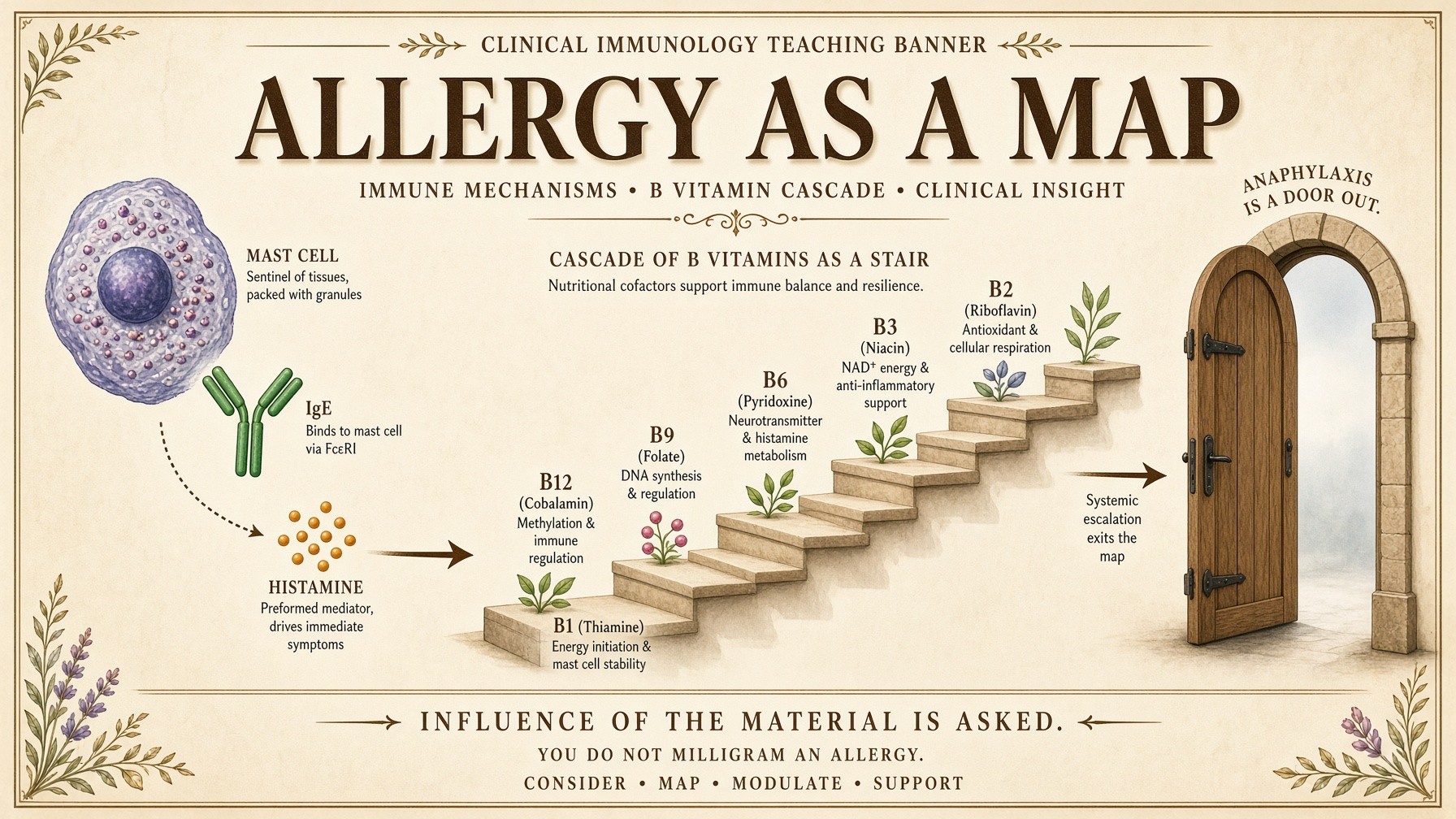
Course 15 closes in the body, not the notebook. Class 15 put the asks in order for allergy I. Every later session still starts with name, permission, alone in the auric field, and stated age. Strong holds; yield gives. Show means hold the name — literacy, not a dose you invent.
The opening
Is this the name? Is it all right if we talk with you? Are you all alone in your auric field? Are you the age you stated? These are not small talk. A yield on permission is a stop. A yield on alone is a cord or a split — you do not run a meridian through occupied space. A yield on age is presenting age, not a lie.
The sequence
Class 15: Questions for Practice Session May 4, 2016
Calibrate for the client's age, entities etc.
Is it OK to ask about food allergies? In this practice session you will need to connect more with the client, turn to the person on the table and talk directly, and tell him what you are finding, and tell him what's happening, what you are doing, and why.
So far most of what we have been doing is reading the questions and talking in midair. Now we need to connect more fully with the client.
The information you are learning is just a vehicle for making the connection with the biofield, the belief system, and the fears and expectations of the person on the table. So this time let's bring him into it.
Here is the vibration of methionine: (show the methionine sample) Can you go from methionine to S-adenosyl methionine?
No? Do you reroute this and make met-enkephalin instead?
Wheat, and/or Meat: (Show the body the wheat sample.) x Turn to the client and say "This is a sample of wheat. Is food made with wheat OK for you to eat?" And wait for him to answer. He might say yes, but his body might be saying no. Explain that to him. Then ask o Do you have a negative emotional association with wheat? If his body says yes, tell him, and give him a chance to talk about it with you.
x Here is a piece of meat. (just pretend) Is this OK for you to eat? o If not, do you have a negative emotional association with meat?
With either one, the same questions apply:
- 1. How old were you when you disconnected from wheat? (or meat?) o Was it before 5? Before 10? Before 20? until you locate the age.
- 2. Now ask your friend to rememfiber what happened. Listen to him. o Test to see which memory or situation he describes is relevant. o Locate the feeling, and identify the meridians. o Trace them. Explain this to him. Retest for wheat.
- 3. Ask: Are there other times when you reinforced this wheat allergy? o Proceed as before.
- 4. Trace the methionine pathway from S-adenosyl methionine to S- adenosyl homocysteine, and homocysteine. o Ask if homocysteine can go into cystathionine. If the body says no, you need to
go into the soy questions.
Soy: (find the soy sample, and also pick up the Threonine sample. )
- 1. Can you make Threonine aldolase? The client won't know that. Test the body and then tell him what it said. o If so, he can very likely synthesize glycine, and then serine. o If the body says no, he probably has a soy allergy.
- 2. Ask what age, and ask if he rememfibers anything that happened. o Listen attentively to the story about his situation, identify the feelings with him, and locate the meridians. Run them.
- 3. Was there another time when you got a soy allergy? o If the body says yes, identify and release each event until they are completed.
- 4. Is the methionine pathway OK all the way to cysteine and taurine? o By now it should be all OK.
Gluten: (Show the body wheat, rye and barley.) x Explain that there is a protein in common with these grains. It is gluten. o If the body days it's OK, that's fine, go on to the next thing. If the answer is no, find the age. Check for a prenatal decision. If it is in a split, find it, lift out the trauma, and return the split. o Ask about subsequent situations, locate the ages, the feelings, and trace the meridians. o After it has been released, check for gluten again. Ask the client if it will be still be OK at the current age, and tell what his body said.
Milk: (show the milk sample)
- 1. Show the tryptophan sample, tell the client that you want to ask about the tryptophan pathway. o Fifirst, ask the body if it can synthesize 5-HPT. If not, explain that it could be due to a toxin. If so, check the detox box, and establish that 5-HTP will be available.
- 2. Can you decarboxylate 5-HTP? (The client won't know that.) o Ask the body: Is the 5-HTP decarboxylase enzyme available?
- 3. If it says no, ask about milk. Milk allergy stops the decarboxylase enzyme. Many clients are aware of milk allergy, and they will tell you. o Explain that milk allergy can block the tryptophan path. If the body agrees that there is a milk allergy, find the age, the feeling, talk about it, run the meridians, and clear milk for each event.
- 4. Your client won't know, (but you will know) that SSRIs block all the decarboxylase enzymes, so the body can't make any monoamines. SSRIs inhibit the synthesis of
serotonin, dopamine, taurine, histamine, and nor-epinephrine.
o Now ask the client: Are you taking anti-depressant drugs? If so, suggest biotin. Explain that biotin stops the side effects, but not the helpful intention of the drug, and the decarboxylases will be protected by the biotin.
- 5. Final question: After all this, body, can you make serotonin?
- 6. OK, now that serotonin is being synthesized, can it be received at the receptor sites? o If the body says no, ask the client if he is drinking tap water, as it would most likely be due to flfluoride. Offer DMAE and retest.
How you use the lab
On yourself first, or a consenting adult. Strong holds; yield gives. If a step says stop, you stop. Walk Kapel's numbered asks in order — do not invent missing steps. When the PDF shows a sample or ingredient, hold the name and ask; this academy does not invent milligram or dosing language. Ethics still holds after the last yes.
Practice
Walk the Class 15 lab on yourself. Journal one sentence: what the body said first, and whether you stopped anywhere.
Check
This Class 15 lab is about:
- Walking Kapel's numbered asks on allergy I — permission first ✓
- Inventing a new clinical protocol
- Skipping the opening four because the PDF is long
Use the PDF sequence. Topic: allergy I.
Talk / permission in this lab is:
- How the hour is asked — not a sixth decorative step ✓
- Optional if you already know the anatomy
- A dose
Is it all right if we talk with you?
Presenting age on this hour:
- Is asked; a yield is not a lie — the field may not be in the present tense ✓
- Is ignored after Class 1
- Is a milligram of years
Are you the age you stated?
When the PDF lists ingredients or samples for allergy I, you:
- Show / hold the name and ask — literacy, not a student prescription ✓
- Write a brand and a milligram from memory
- Skip occupancy
Kapel's list stays a list of questions.
After the last clean yes:
- Ethics still holds — you do not invent more work so the hour feels complete ✓
- You must finish every number on the page
- You prescribe what was shown
Stop inventing work.
The Class 15 lab opens with:
- A favorite color, a mantra, and a crystal grid
- Name, permission to talk, alone in the auric field, and stated age — then the class asks ✓
- A milligram list you write before the first yes
Every later ask belongs on that permission. Occupancy before the trace.
A yield on permission is:
- A suggestion to press harder
- A stop ✓
- A dose you write
You do not run a meridian through a no.
“Are you all alone in your auric field?” — a yield means:
- Talk louder so the field can hear
- There is company — a cord or a split — and you do not invent chemistry yet ✓
- The person has failed the course
Company in the field is not a channel problem. Check cords and splits first.
Show / hold a name in this lab means:
- Write a milligram and a brand
- Hold the name as a question — literacy, not a dose you invent ✓
- Skip permission because the PDF listed an ingredient
Kapel's list is asked. This academy does not invent dosing language.
If a step says stop, you:
- Skip it so the lab looks complete
- Stop. The field still holds after the last yes ✓
- Press harder until you find a problem
On yourself first. Strong holds; yield gives.