
Class 36 Lab · 14 min
Ask the rest
A read of this page, with the plate.
Name. Permission. Alone in the field. Age. Then the class asks — and only then the work.
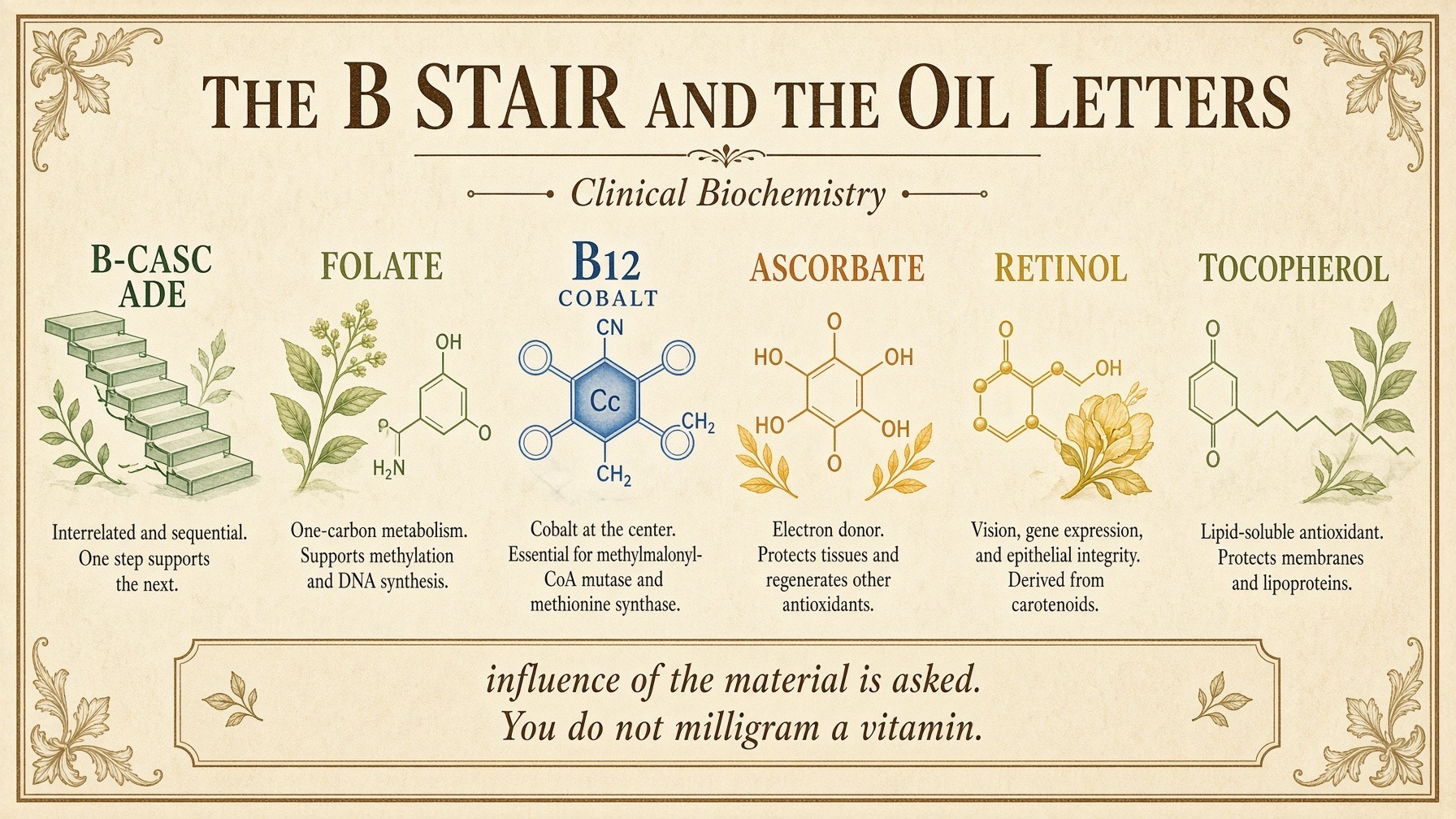
Course 36 closes in the body, not the notebook. Class 36 put the asks in order for vitamins II — B, oil-soluble, C. Every later session still starts with name, permission, alone in the auric field, and stated age. Strong holds; yield gives. Show means hold the name — literacy, not a dose you invent.
The opening
Is this the name? Is it all right if we talk with you? Are you all alone in your auric field? Are you the age you stated? These are not small talk. A yield on permission is a stop. A yield on alone is a cord or a split — you do not run a meridian through occupied space. A yield on age is presenting age, not a lie.
The sequence
Questions for Vitamins
B1
- 1. Body, are you receiving all of the B1 you need? Do you have su cient B12, Choline &
Vit A to phosphorylate it into thiamin pyrophosphate? And do you make as much TPP (Thiamin PyroPhosphate) as you need?
- 2. Does TPP help you metabolize carbohydrates?
- 3. Does TPP help you to decarboxylate pyruvate to form acetyl-coenzyme A?
B3
- 1. Do you make B3 from tryptophan? Do you also assimilate it from food?
- 2. Are you able to derive NAD from B3?
- 3. Does B3 help you to regulate your cholesterol levels?
Vitamin A
- 1. Body, do you see the di erence between beta-carotene and preformed Vitamin A?
(Prac oner - do you?)
- 2. Do you receive beta-carotene from the plant material you eat? Do you receive pre- form Vitamin A from animal products that you eat? Are you able to u lize both the beta-carotene and the preformed Vit A?
- 3. Body, do you convert beta-carotene to Vitamin A by spli ng it into two molecules?
Do you use water, inositol and P5P to make this conversion?
- 4. ** Prac oner - now ask about some of the uses of Vit A, as relates to this body **
Vitamin D
- 1. Body, do you make Vitamin D in the form of cholecalciferol (Vit D3) when your skin is exposed to sunlight?
- 2. Do you then transport the Vit D3 to the liver? Then does liver hydroxylate it to make
25hydroxy vitamin D3?
- 3. When kidneys receive the 25-hydroxy vitamin D3, do they also hydroxylate it to make
1,25-dihydroxycholecalciferol?
- 4. Body, does this ac ve form of Vitamin D, along with parathyroid hormone, maintain the proper balance of Calcium in the blood?
- 5. Does Vitamin D also help enhance your immune system func on?
Vitamin K
- 1. Is Vitamin K involved in the distribu on of zinc in the re ec ve zinc plate? Does the zinc plate enhance the ability to see in low levels of light?
- 2. Is Vitamin K used for adding carboxyl groups to proteins that bind calcium?
ti ti ti ti ti ti ff ti fl tti ti ti ffi ti
Vitamin E
- 1. Body, do you have su cient bile to complete the absorp on of Vitamin E? Do you also have su cient lipase?
- 2. Do you receive all of the Vitamin E you need? Are you able to store it in liver and fat cells?
- 3. ** Prac oner - ask about some of the func ons of Vit E - see chart **
Vitamin C
- 1. Do you receive all of the Vitamin C you need each day?
- 2. Do you fully u lize the vitamin C you receive?
- 3. Do you use it in making collagen?
- 4. Do you use it in the tyrosine cascade? To make carni ne?
- 5. Does your immune system (killer cells) use Vitamin C, along with peroxide, to a ack invading organisms?
ti ti ffi ti ffi ti ti ti tt
How you use the lab
On yourself first, or a consenting adult. Strong holds; yield gives. If a step says stop, you stop. Walk Kapel's numbered asks in order — do not invent missing steps. When the PDF shows a sample or ingredient, hold the name and ask; this academy does not invent milligram or dosing language. Ethics still holds after the last yes.
Practice
Walk the Class 36 lab on yourself. Journal one sentence: what the body said first, and whether you stopped anywhere.
Check
This Class 36 lab is about:
- Walking Kapel's numbered asks on vitamins II — B, oil-soluble, C — permission first ✓
- Inventing a new clinical protocol
- Skipping the opening four because the PDF is long
Use the PDF sequence. Topic: vitamins II — B, oil-soluble, C.
Talk / permission in this lab is:
- How the hour is asked — not a sixth decorative step ✓
- Optional if you already know the anatomy
- A dose
Is it all right if we talk with you?
Presenting age on this hour:
- Is asked; a yield is not a lie — the field may not be in the present tense ✓
- Is ignored after Class 1
- Is a milligram of years
Are you the age you stated?
When the PDF lists ingredients or samples for vitamins II — B, oil-soluble, C, you:
- Show / hold the name and ask — literacy, not a student prescription ✓
- Write a brand and a milligram from memory
- Skip occupancy
Kapel's list stays a list of questions.
After the last clean yes:
- Ethics still holds — you do not invent more work so the hour feels complete ✓
- You must finish every number on the page
- You prescribe what was shown
Stop inventing work.
The Class 36 lab opens with:
- A favorite color, a mantra, and a crystal grid
- Name, permission to talk, alone in the auric field, and stated age — then the class asks ✓
- A milligram list you write before the first yes
Every later ask belongs on that permission. Occupancy before the trace.
A yield on permission is:
- A suggestion to press harder
- A stop ✓
- A dose you write
You do not run a meridian through a no.
“Are you all alone in your auric field?” — a yield means:
- Talk louder so the field can hear
- There is company — a cord or a split — and you do not invent chemistry yet ✓
- The person has failed the course
Company in the field is not a channel problem. Check cords and splits first.
Show / hold a name in this lab means:
- Write a milligram and a brand
- Hold the name as a question — literacy, not a dose you invent ✓
- Skip permission because the PDF listed an ingredient
Kapel's list is asked. This academy does not invent dosing language.
If a step says stop, you:
- Skip it so the lab looks complete
- Stop. The field still holds after the last yes ✓
- Press harder until you find a problem
On yourself first. Strong holds; yield gives.