
Class 35 Lab · 14 min
Ask Chart 1-1
A read of this page, with the plate.
Name. Permission. Alone in the field. Age. Then the class asks — and only then the work.
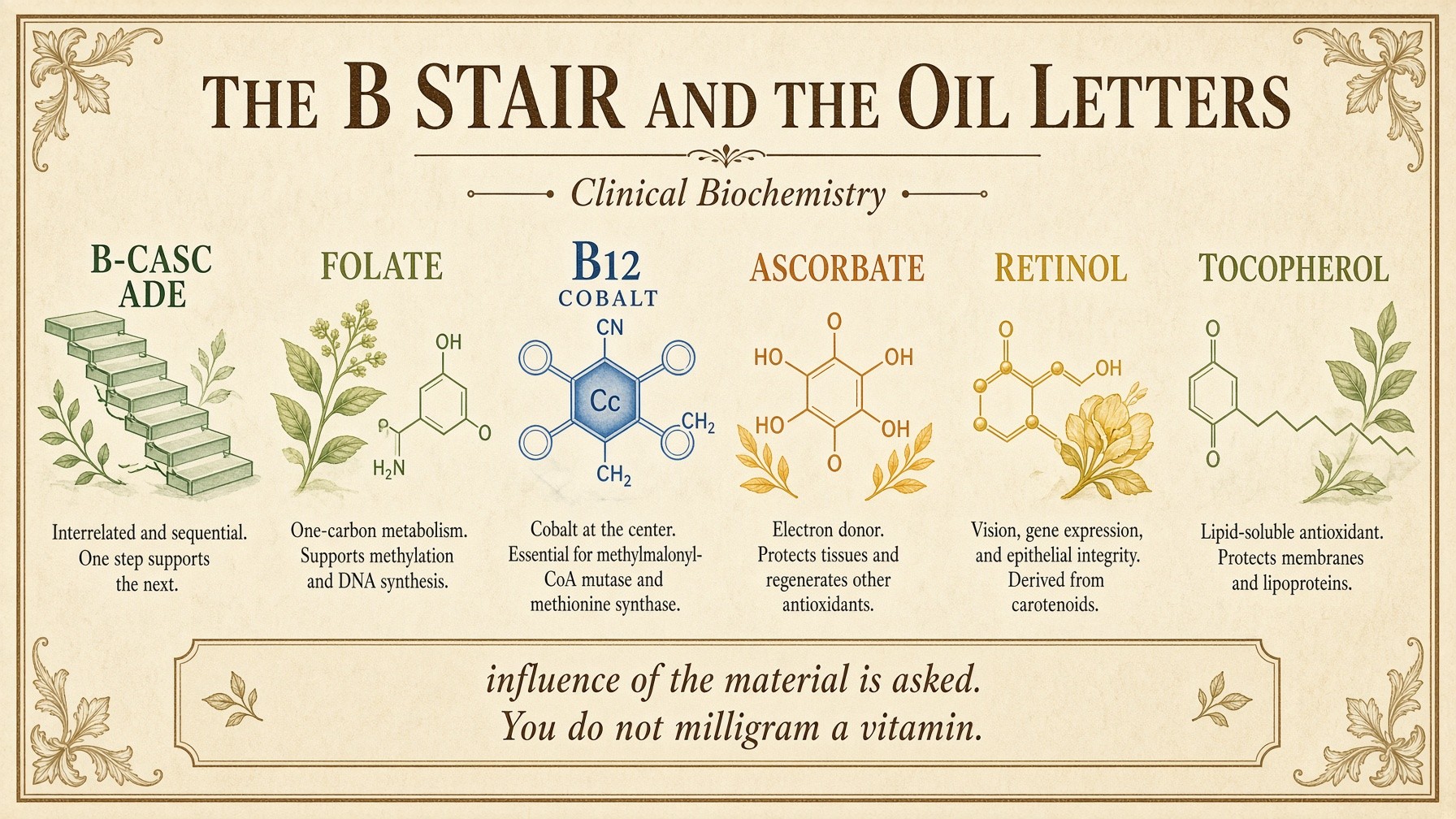
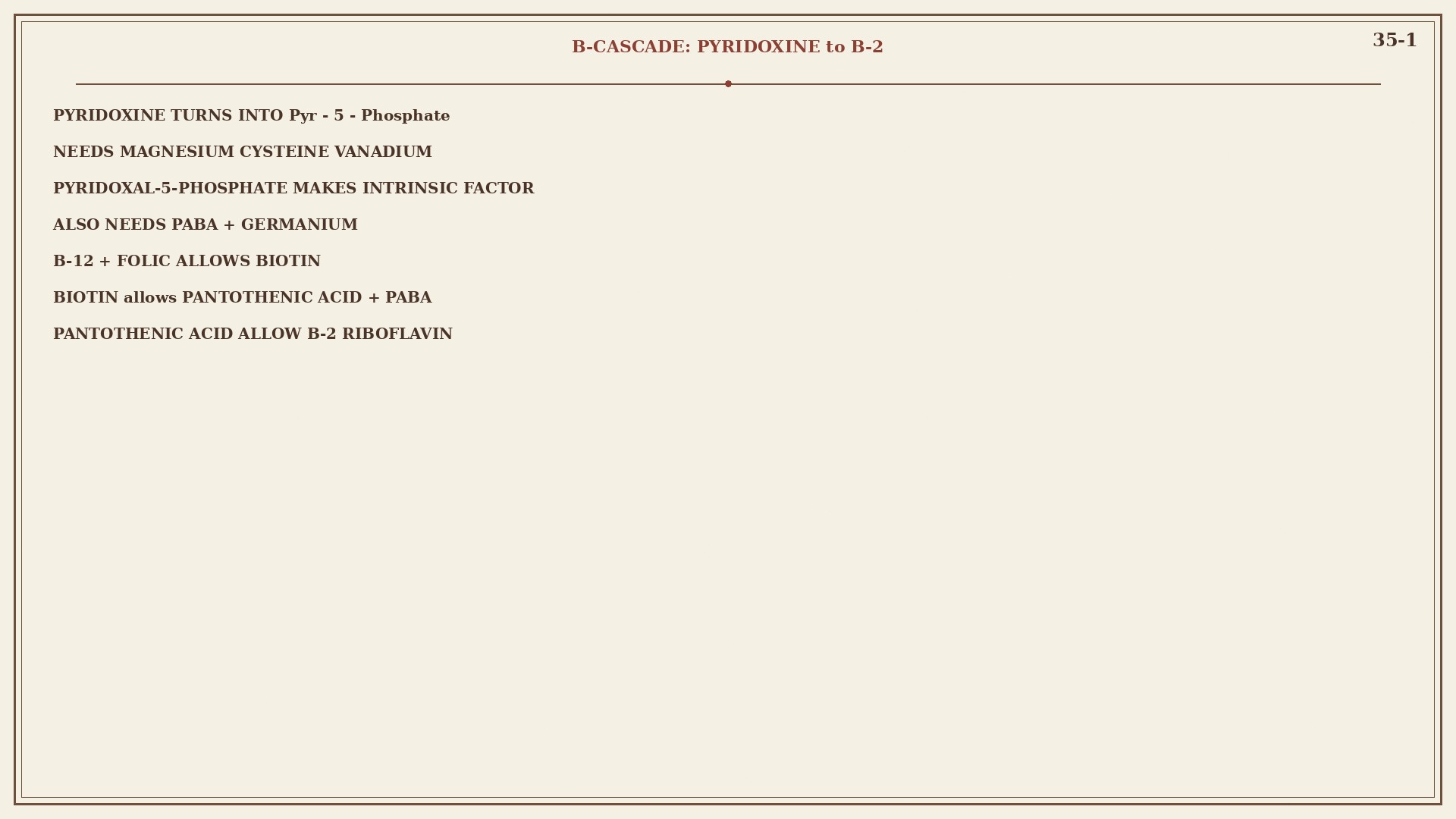
Course 35 closes in the body, not the notebook. Class 35 put the asks in order for vitamins I — B-cascade, choline, inositol. Every later session still starts with name, permission, alone in the auric field, and stated age. Strong holds; yield gives. Show means hold the name — literacy, not a dose you invent.
The opening
Is this the name? Is it all right if we talk with you? Are you all alone in your auric field? Are you the age you stated? These are not small talk. A yield on permission is a stop. A yield on alone is a cord or a split — you do not run a meridian through occupied space. A yield on age is presenting age, not a lie.
The sequence
Inositol - Lab
*Review each step of the B vitamin cascade (below)
B6
- 1. Body, are you getting enough Vitamin B6? Are you conver ng your B6 to pyridoxal -5-phosphate (aka P-5-P)? Do you have the magnesium, cysteine and vanadium you need to make that conversion?
Folic Acid
- 1. Body, are you getting the folic acid you need from your diet?
- 2. Are you able to convert the folic to THFA (picture the folic breaking the two double bonds and inser ng 4 hydrogens to make tetra (4) hydro (hydrogens) folic acid-THFA)?
- 3. Are you absorbing and u lizing the THFA?
Intrinsic factor and B12
- 1. Do you make intrinsic factor in the parietal cells of the stomach? Do you have the B6 (as P-5-P) to make the intrinsic factor?
- 2. Does the intrinsic factor protect the B12 so that it can go through the diges ve process and be absorbed through the ileum of the small intestine?
- 3. Are you bringing in enough B12 through your diet? Are you absorbing it? Is the B12 getting into the cells?
Bio n
- 1. Do you have the B12, THFA and the germanium you need to bring in the bio n?
- 2. Is your bio n synthesized and absorbed in the large intestine?
- 3. Does the bio n help you with protein u liza on? Oxida on of fa y acids?
Does it help to lower your cholesterol? Heal derma s? Does it help you to maintain high energy? Res ul sleep?
- 4. If you were taking a pharmaceu cal drug, would bio n help you to release side e ects while allowing the drug to do what it's prescribed to do?
ti ti ff tti ti ti tti tti ti ti tf ti ti ti ti ti ti ti ti ti ti tt ti
PABA (Para-amino-benzoic acid)
- 1. Body, does the bio n allow you to bring in the PABA? Are you getting enough
PABA? Are you absorbing it?
- 2. Does the PABA help with folic synthesis? Does it sooth membranes? Does it help to keep the skin so ? If you had asthma, would it be helpful? Does it assist with the distribu on of pigment in the body? Does it help to prevent cons pa on? Headaches?
- 3. Body do you have the PABA you need to convert citrulline to aspar c acid in the urea cycle?
B5 / Pantothenic Acid
- 1. Body, do you bring in the vitamin B5? Do you have the bio n you need to do that? Are you absorbing the B5?
- 2. If you were ea ng lots and lots of sugar, would your B5 work as well? How about if you were under enormous stress, then would your B5 be less than optimal?
- 3. If you didn't have enough B5, would you be able to make the Coenzyme A you need to make and use fa y acids?
- 4. Do you have the B5 you need for the adrenals? For an body forma on? To make stomach acid with B1 and Vitamin A? For cholesterol synthesis? For nerve transmission?
B2 / Ribo avin
- 1. Body, do you have the B5 you need to bring in the B2? Are you absorbing B2?
Do you get enough from your diet?
- 2. Body, do you have the B2 you need to process your branch chain amino acids?
To allow for proper u liza on of lysine? To assist with cellular uptake of oxygen? To assist in conver ng glucose to ATP in the Krebs cycle?
ti ti ti fl ti ti ti ti ft tt ti ti ti ti tti
[Sequence continues in the Class PDF — walk the remaining numbered asks in order. Do not invent steps.]
How you use the lab
On yourself first, or a consenting adult. Strong holds; yield gives. If a step says stop, you stop. Walk Kapel's numbered asks in order — do not invent missing steps. When the PDF shows a sample or ingredient, hold the name and ask; this academy does not invent milligram or dosing language. Ethics still holds after the last yes.
Practice
Walk the Class 35 lab on yourself. Journal one sentence: what the body said first, and whether you stopped anywhere.
Check
This Class 35 lab is about:
- Walking Kapel's numbered asks on vitamins I — B-cascade, choline, inositol — permission first ✓
- Inventing a new clinical protocol
- Skipping the opening four because the PDF is long
Use the PDF sequence. Topic: vitamins I — B-cascade, choline, inositol.
Talk / permission in this lab is:
- How the hour is asked — not a sixth decorative step ✓
- Optional if you already know the anatomy
- A dose
Is it all right if we talk with you?
Presenting age on this hour:
- Is asked; a yield is not a lie — the field may not be in the present tense ✓
- Is ignored after Class 1
- Is a milligram of years
Are you the age you stated?
When the PDF lists ingredients or samples for vitamins I — B-cascade, choline, inositol, you:
- Show / hold the name and ask — literacy, not a student prescription ✓
- Write a brand and a milligram from memory
- Skip occupancy
Kapel's list stays a list of questions.
After the last clean yes:
- Ethics still holds — you do not invent more work so the hour feels complete ✓
- You must finish every number on the page
- You prescribe what was shown
Stop inventing work.
The Class 35 lab opens with:
- A favorite color, a mantra, and a crystal grid
- Name, permission to talk, alone in the auric field, and stated age — then the class asks ✓
- A milligram list you write before the first yes
Every later ask belongs on that permission. Occupancy before the trace.
A yield on permission is:
- A suggestion to press harder
- A stop ✓
- A dose you write
You do not run a meridian through a no.
“Are you all alone in your auric field?” — a yield means:
- Talk louder so the field can hear
- There is company — a cord or a split — and you do not invent chemistry yet ✓
- The person has failed the course
Company in the field is not a channel problem. Check cords and splits first.
Show / hold a name in this lab means:
- Write a milligram and a brand
- Hold the name as a question — literacy, not a dose you invent ✓
- Skip permission because the PDF listed an ingredient
Kapel's list is asked. This academy does not invent dosing language.
If a step says stop, you:
- Skip it so the lab looks complete
- Stop. The field still holds after the last yes ✓
- Press harder until you find a problem
On yourself first. Strong holds; yield gives.