
Class 30 Lab · 14 min
Ask the letters
A read of this page, with the plate.
Name. Permission. Alone in the field. Age. Then the class asks — and only then the work.
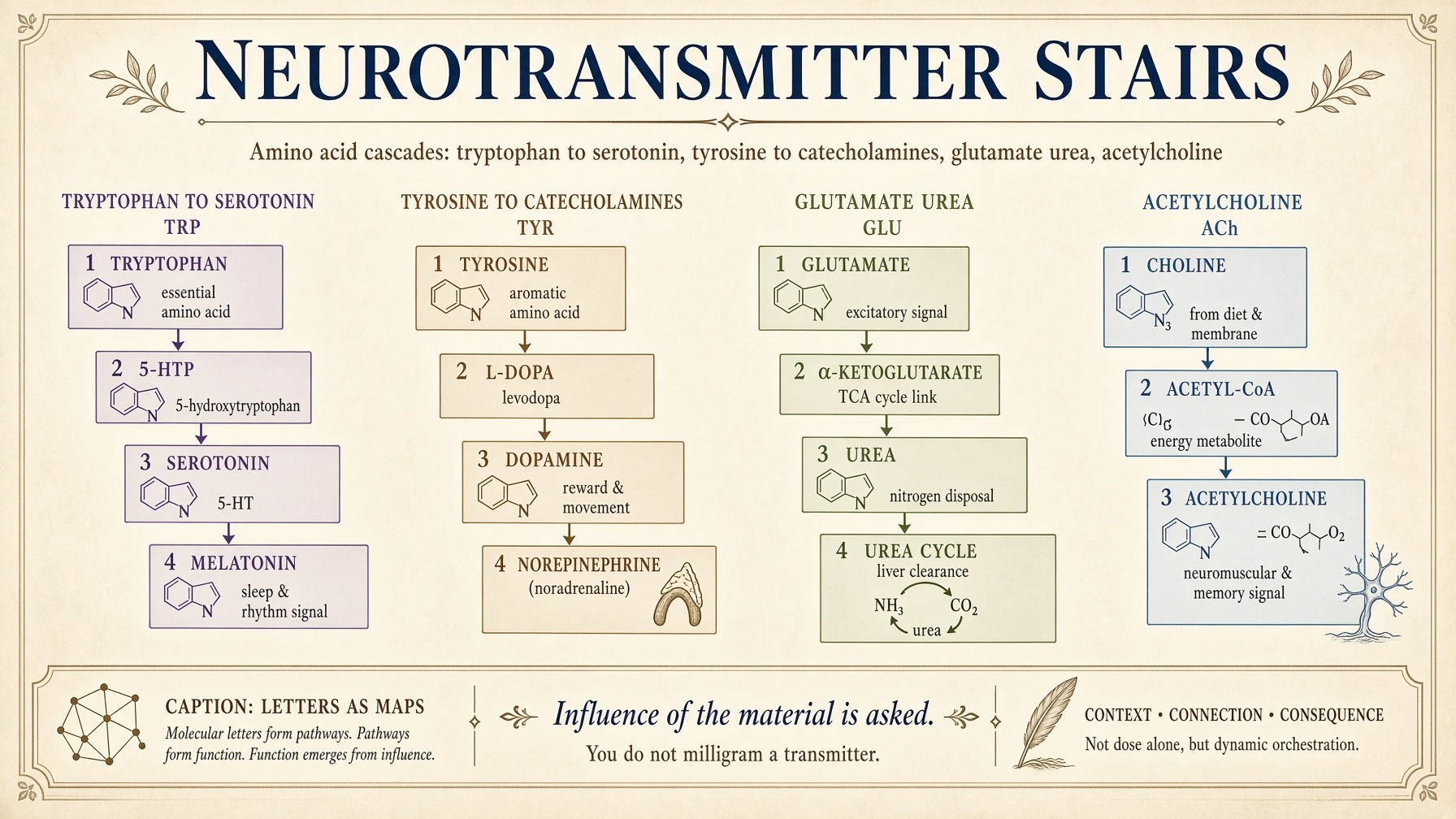
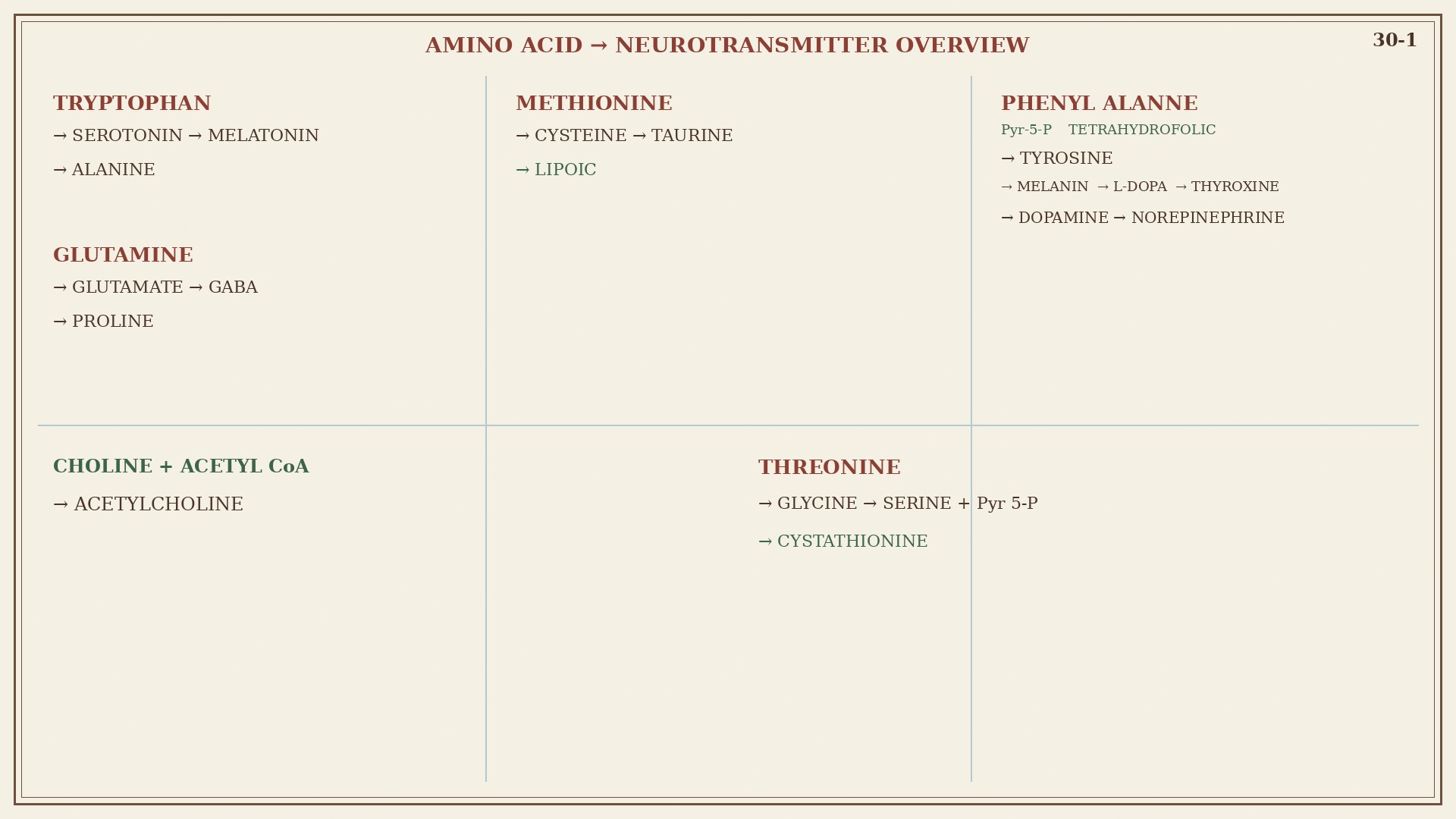
Course 30 closes in the body, not the notebook. Class 30 put the asks in order for neurotransmitters. Every later session still starts with name, permission, alone in the auric field, and stated age. Strong holds; yield gives. Show means hold the name — literacy, not a dose you invent.
The opening
Is this the name? Is it all right if we talk with you? Are you all alone in your auric field? Are you the age you stated? These are not small talk. A yield on permission is a stop. A yield on alone is a cord or a split — you do not run a meridian through occupied space. A yield on age is presenting age, not a lie.
The sequence
Class 30 - Neurotransmitter Synthesis Lab Questions
Serotonin (Chart 30-2)
- 1. Body, can we talk about your serotonin?
- 2. Do you see the picture of tryptophan that I'm showing you? Do you get enough of it in your diet? (Turkey, milk, protein foods.) Could you use more?
- 3. Can you hydroxylate the tryptophan, making 5 hydroxytryptophan?
- 4. Do you have an adequate amount of the enzyme tryptophan hydroxylase? (If not, check p-5-p, rubidium and zinc, 7th chakra cords.)
- 5. Are you making 5 hydroxytryptophan perfectly? Are you making enough? (If not, check for milk allergy (mom-stuff), pharmaceuticals, pesticides, herbicides, petroleum products, household toxins, fluoridation)
- 6. Can you then decarboxylate your 5 hydroxytryptophan, making serotonin? (If not, do you have enough of the enzyme 5-hydroxytryptophan decarboxylase?)
- 7. Are you getting enough sunlight to support the production of serotonin?
- 8. If you had an adequate amount of perfect serotonin (along with dopamine), would it help you signal the release of hypothalamic neurohumors? Could you better regulate your temperature, sleep cycles, menstrual cycles?
Melatonin
- 9. When it gets dark, can your pineal gland make an enzyme that converts your serotonin into melatonin?
- 10. Does that enzyme and serotonin migrate to the raphe nucleus of the reticular formation in the upper part of the brainstem?
- 11. Is that where you convert your serotonin into melatonin?
- 12. Are you doing that perfectly?
- 13. In the morning when it is light, are you able to convert your melatonin back into serotonin?
Catecholamines (Chart 30-5)
- 14. Do you see this picture of the phenylalanine cascade?
- 15. Do you have enough phenylalanine? Are you are using it perfectly?
- 16. Can you hydroxylate it and make tyrosine exactly like the picture? (If not, check folic, B6, methionine cascade.)
- 17. Can you then add another hydroxyl on the phenyl group to make L-Dopa?
- 18. Can you take the L-Dopa, decarboxylate it, and make dopamine in the substantia nigra?
- 19. Can you add another hydroxyl to the dopamine and make norepinephrine in the locus ceruleus?
- 20. Can you add a methyl group to the norepinephrine and make epinephrine?
Acetylcholine (Chart 30-6)
- 21. Body, can we talk about your acetylcholine?
- 22. Do you have a sense of quiet attention and focus that comes from having the right amount of acetylcholine in your brain?
- 23. Is acetylcholine being made in the synaptic knobs by combining choline with an acetyl radical?
- 24. Do you have enough choline acetyltransferase to make acetylcholine? (If not, check for aspartame.)
- 25. Do you have enough choline?
- 26. Can you pull the methyls you need from methionine to make choline? (If not, check cascade, usage, wheat/meat allergy.)
- 27. Is the acetyl radical available—from Acetyl CoA?
- 28. Can you break down ACh with acetyl-cholinesterase? (If not, check molybdenum.) And then re- combine it?
- 29. Are there allergies or toxins (e.g., flfluoride, aspartame, anesthesia, metals) getting in the way of synthesizing or breaking down acetylcholine?
- 30. Do you need any nutritional support? (possibly molybdenum, germanium)
Glutamine, Glutamate, GABA (Chart 30-7)
- 31. Can we talk to you about your glutamine, glutamate and GABA?
- 32. Can you take glutamine and make glutamate (also known as glutamic acid)?
- 33. Can you do this perfectly? Do you have the right amount of glutamate to support the memory centers of the brain called the hippocampi?
- 34. Do you also use glutamate as a transmitter substance in your hypothalamus?
- 35. Can you take glutamic acid and make GABA? (If not, check germanium, B12, metals, allergies [fume and fuel], flfluoride exposure, toxins.)
- 36. Does your GABA work to restrain excess firing of acetylcholine signals in the brain?
Glycine (Chart 30-8)
- 37. Body, can we talk to you about your glycine?
- 38. Can you make glycine from threonine? (If not, check soy allergy.)
- 39. Do you have a comfortable amount of glycine along your spine?
Taurine (Chart 30-4)
- 40. Brain, can we talk to you about taurine?
- 41. Are you synthesizing taurine from cysteine?
- 42. Is there any area in your brain that is not receiving the appropriate amount of taurine?
How you use the lab
On yourself first, or a consenting adult. Strong holds; yield gives. If a step says stop, you stop. Walk Kapel's numbered asks in order — do not invent missing steps. When the PDF shows a sample or ingredient, hold the name and ask; this academy does not invent milligram or dosing language. Ethics still holds after the last yes.
Practice
Walk the Class 30 lab on yourself. Journal one sentence: what the body said first, and whether you stopped anywhere.
Check
This Class 30 lab is about:
- Walking Kapel's numbered asks on neurotransmitters — permission first ✓
- Inventing a new clinical protocol
- Skipping the opening four because the PDF is long
Use the PDF sequence. Topic: neurotransmitters.
Talk / permission in this lab is:
- How the hour is asked — not a sixth decorative step ✓
- Optional if you already know the anatomy
- A dose
Is it all right if we talk with you?
Presenting age on this hour:
- Is asked; a yield is not a lie — the field may not be in the present tense ✓
- Is ignored after Class 1
- Is a milligram of years
Are you the age you stated?
When the PDF lists ingredients or samples for neurotransmitters, you:
- Show / hold the name and ask — literacy, not a student prescription ✓
- Write a brand and a milligram from memory
- Skip occupancy
Kapel's list stays a list of questions.
After the last clean yes:
- Ethics still holds — you do not invent more work so the hour feels complete ✓
- You must finish every number on the page
- You prescribe what was shown
Stop inventing work.
The Class 30 lab opens with:
- A favorite color, a mantra, and a crystal grid
- Name, permission to talk, alone in the auric field, and stated age — then the class asks ✓
- A milligram list you write before the first yes
Every later ask belongs on that permission. Occupancy before the trace.
A yield on permission is:
- A suggestion to press harder
- A stop ✓
- A dose you write
You do not run a meridian through a no.
“Are you all alone in your auric field?” — a yield means:
- Talk louder so the field can hear
- There is company — a cord or a split — and you do not invent chemistry yet ✓
- The person has failed the course
Company in the field is not a channel problem. Check cords and splits first.
Show / hold a name in this lab means:
- Write a milligram and a brand
- Hold the name as a question — literacy, not a dose you invent ✓
- Skip permission because the PDF listed an ingredient
Kapel's list is asked. This academy does not invent dosing language.
If a step says stop, you:
- Skip it so the lab looks complete
- Stop. The field still holds after the last yes ✓
- Press harder until you find a problem
On yourself first. Strong holds; yield gives.