
Class 32 Lab · 14 min
Ask the wheel
A read of this page, with the plate.
Name. Permission. Alone in the field. Age. Then the class asks — and only then the work.
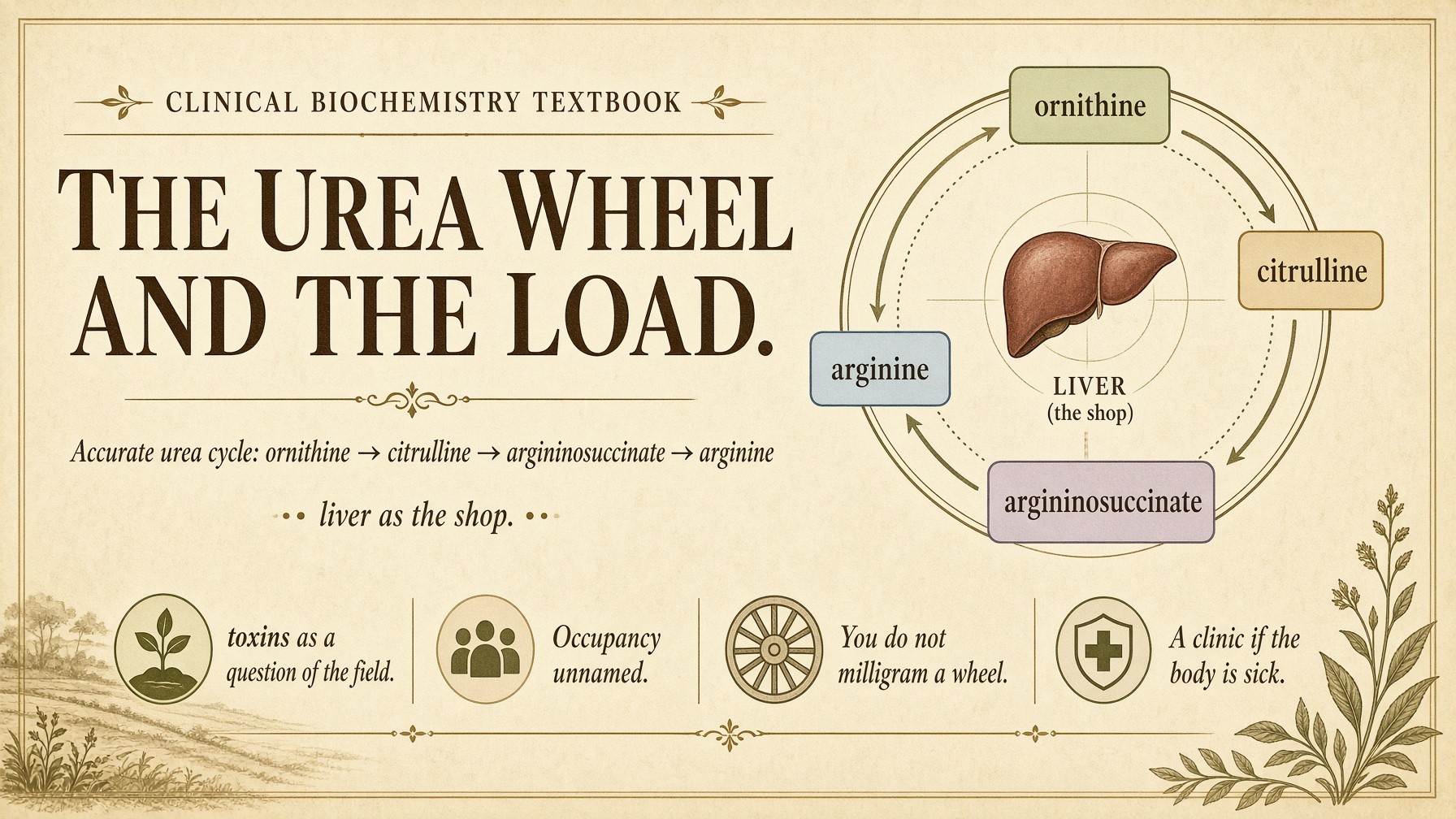
Course 32 closes in the body, not the notebook. Class 32 put the asks in order for toxins. Every later session still starts with name, permission, alone in the auric field, and stated age. Strong holds; yield gives. Show means hold the name — literacy, not a dose you invent.
The opening
Is this the name? Is it all right if we talk with you? Are you all alone in your auric field? Are you the age you stated? These are not small talk. A yield on permission is a stop. A yield on alone is a cord or a split — you do not run a meridian through occupied space. A yield on age is presenting age, not a lie.
The sequence
Questions for Class 32: Toxins, Poisons, and Pharmaceuticals
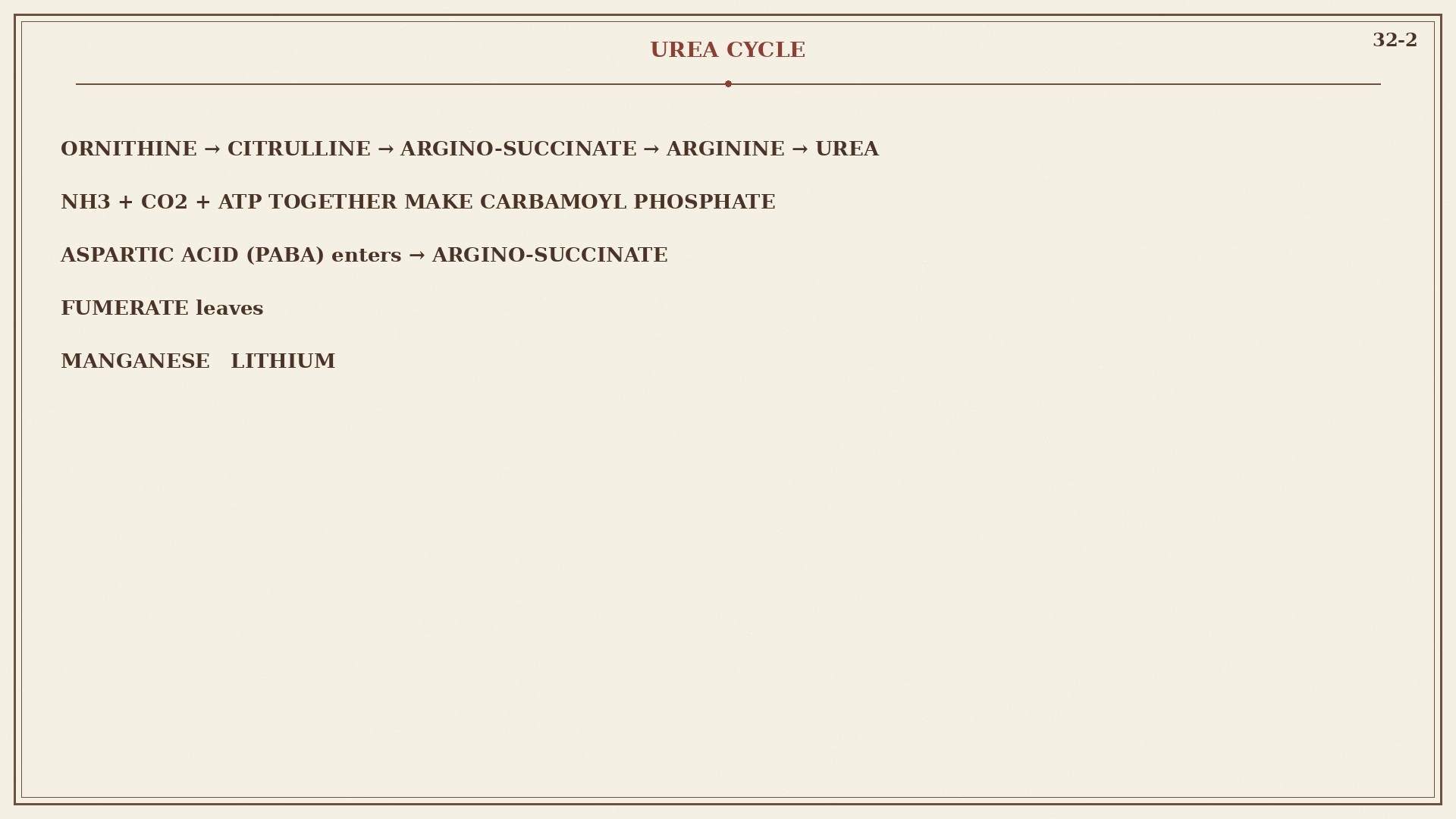
Urea Cycle
- 1. Is the energy field of your liver optimal? (If no, how you can support the liver emotionally and physically? Check out detox box, Vit. C., Kyolic, Systox, Geotox, etc.)
- 2. Do you have more of this in your blood than you'd like? (Show the body your vial of ammonia.)
- 3. If yes, hold these four samples over the liver: ornithine, citrulline, aspartic acid and arginine.
Liver, do you undefirstand the sequence of reactions that relate to these substances? Does it allow you to change ammonia into urea that can then be discarded by the kidneys?
- 4. Can the carbamoyl phosphate draw in the ammonia to combine with ornithine? (If no, to #13.)
- 5. Can you take the ornithine, bring in manganese (show it a sample), and make citrulline? (If client drinks water with chloramines, manganese may be at risk.)
- 6. Can you take the citrulline and pull in PABA to make aspartic acid? (Check B cascade-PABA.)
- 7. Can you make the transition from asparagine to aspartic acid? (Check potato allergy.)
- 8. Can you convert the aspartic acid to arginosuccinate?
- 9. Can the arginosuccinate then throw off the fumerate to make arginine?
- 10. Do you have enough lithium to make the enzyme arginase?
- 11. Can the arginase then split the arginine into urea and ornithine?
- 12. Can your body then dispose of the urea?
- 13. Do you have the right amount of ornithine available?
- 14. (If not, ask) Is there were enough arginine could you make ornithine?
- 15. (If yes, ask) Do you have enough arginase available? (Needs lithium.)
- 16. If no, ask "would there be enough arginine if the fumerate had been released?"
- 17. Would it take more arginosuccinate to make enough arginine?
- 18. If yes, ask Are you going to have the amount of aspartic acid that you need?
- 19. If there's not enough aspartic acid, ask Do you have enough PABA to facilitate the synthesis of aspartic acid from asparagine? Check B cascade. Potato allergy could block asparagine util.
- 20. Is the urea cycle now working? Is there another reason you have too much ammonia? (Check fungus, parasites, unresolved anger, etc.)
Minerals/Heavy Metals
- 21. (Hold the mineral test-kit box above the body.) Can you see all these minerals? Can you see any you'd like to have more of? (Test ability to use, dosage, liver's ability to transport.)
- 22. Has a shortage of a mineral allowed heavy metals into your body?
- 23. Do you have any heavy metals? (If so, test lead, cadmium, mercury, bismuth, arsenic, and
[light-metal] aluminum. If you have samples, show them to the body.)
- 24. Would one of these fixers help you let go of the heavy metal? (Test body for fixers: calcium, magnesium, iron, chromium, manganese or zinc, Metalotox, Vitamin C, Kyolic, NAC, methionine, glutathione, SOD, etc. Show the body the entire box of fixers; let it pick.
- 25. You may also want to try holding your hands over client's body where the metals are, sending a sixth chakra beam through your hands until you feel a shift. Notice if something palpable releases up into your hands. Test to see if it has shifted the metals.
Pesticides and Herbicides
- 26. Ask both the client and the body: Have you had exposure to pesticides or herbicides? The client may rememfiber specific instances. Show the body molecular drawings on cards and in textbook.
- 27. If she received it in food, make sure to ask your client to imagine her version of the food. If she then reacts, you will know it is to the pesticides or additives that your test kit does not contain.
- 28. Ask if she is able to detoxify the substance at the current exposure
- 29. Ask if she is able to handle substance when presented on its own, not in combination with something else
How you use the lab
On yourself first, or a consenting adult. Strong holds; yield gives. If a step says stop, you stop. Walk Kapel's numbered asks in order — do not invent missing steps. When the PDF shows a sample or ingredient, hold the name and ask; this academy does not invent milligram or dosing language. Ethics still holds after the last yes.
Practice
Walk the Class 32 lab on yourself. Journal one sentence: what the body said first, and whether you stopped anywhere.
Check
This Class 32 lab is about:
- Walking Kapel's numbered asks on toxins — permission first ✓
- Inventing a new clinical protocol
- Skipping the opening four because the PDF is long
Use the PDF sequence. Topic: toxins.
Talk / permission in this lab is:
- How the hour is asked — not a sixth decorative step ✓
- Optional if you already know the anatomy
- A dose
Is it all right if we talk with you?
Presenting age on this hour:
- Is asked; a yield is not a lie — the field may not be in the present tense ✓
- Is ignored after Class 1
- Is a milligram of years
Are you the age you stated?
When the PDF lists ingredients or samples for toxins, you:
- Show / hold the name and ask — literacy, not a student prescription ✓
- Write a brand and a milligram from memory
- Skip occupancy
Kapel's list stays a list of questions.
After the last clean yes:
- Ethics still holds — you do not invent more work so the hour feels complete ✓
- You must finish every number on the page
- You prescribe what was shown
Stop inventing work.
The Class 32 lab opens with:
- A favorite color, a mantra, and a crystal grid
- Name, permission to talk, alone in the auric field, and stated age — then the class asks ✓
- A milligram list you write before the first yes
Every later ask belongs on that permission. Occupancy before the trace.
A yield on permission is:
- A suggestion to press harder
- A stop ✓
- A dose you write
You do not run a meridian through a no.
“Are you all alone in your auric field?” — a yield means:
- Talk louder so the field can hear
- There is company — a cord or a split — and you do not invent chemistry yet ✓
- The person has failed the course
Company in the field is not a channel problem. Check cords and splits first.
Show / hold a name in this lab means:
- Write a milligram and a brand
- Hold the name as a question — literacy, not a dose you invent ✓
- Skip permission because the PDF listed an ingredient
Kapel's list is asked. This academy does not invent dosing language.
If a step says stop, you:
- Skip it so the lab looks complete
- Stop. The field still holds after the last yes ✓
- Press harder until you find a problem
On yourself first. Strong holds; yield gives.