
Class 10 Lab · 11 min
Follow the food
A read of this page, with the plate.
Name. Permission. Alone. Age. Hello, stomach. Gastrin on a smell? Vagus? Mucus first. Then a spiral in the lining. Then acid. Then intrinsic factor and B-12. Then pepsinogen. Then the pylorus. Then Oddi. Then the cardiac orifice. Samples do not. Thank the field.
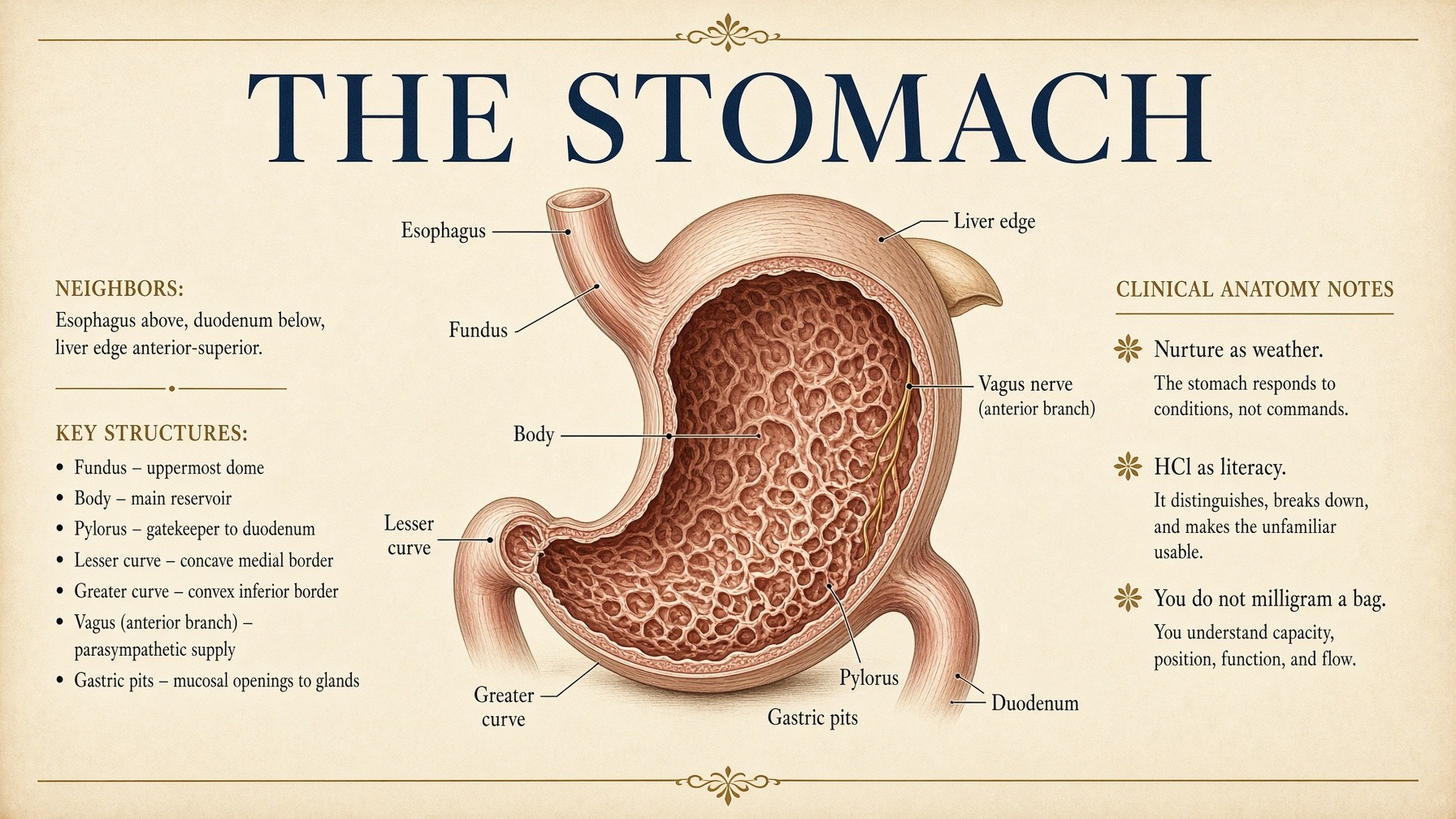
Course 10 closes in the body, not the notebook. Class 10 put the asks in order for stomach function — follow the food. Every later session still starts with name, permission, alone in the auric field, and stated age. Strong holds; yield gives. Show means hold the name — literacy, not a dose you invent.
The opening
Is this the name? Is it all right if we talk with you? Are you all alone in your auric field? Are you the age you stated? These are not small talk. A yield on permission is a stop. A yield on alone is a cord or a split — you do not run a meridian through occupied space. A yield on age is presenting age, not a lie.
The sequence
Questions for Class 10 Stomach _ March 30" 2016
Questions for Checking Stomach Function
Let's follow the food
- 1. Hello Stomach, is it OK to talk to you? When your owner smells food, do your hormone-producing cells start to secrete the hormone Gastrin?
Is the signal for gastrin coming down from the hypothalamus, through the vagus nerve?
If stomach says yes, your client is in parasympathetic mode, in a relaxed state.
If it says no, he is in sympathetic mode, the fight-and-flight mode of the nervous system, and in an anxious state.
Can you suggest a way to relax and go into parasympathetic mode? Ask if there are negative emotional associations with eating meals together as a family, and run the meridians that come up, to ease the stress that comes up with digestion.
- 2. Do you secrete enough mucus to protect your stomach lining? If not, ask the hypothalamus if it can signal for that.
Ask about Helicobacter pylori. If yes, show the remedy and ask.
- 3. When you can produce the mucus and it is protecting the stomach lining, do your parietal cells secrete the right amount of hydrochloric acid?
If not, do you need something to help you synthesize it? Show the needed
ingredients:
a. Thiamine pyrophosphate. (B-1 needs to be phosphorylated) b. Pantothenic acid. It may need biotin or B-12 before the body can use it.
c. Vitamin A, Retinol , (this is an oil soluble vitamin.) Suggest taking it with a meal containing oils or fats. If you take it as beta carotene, B-6 will cut the beta carotene in half, giving you two molecules of retinol. Yellow and orange foods contain beta carotene: carrots, garnet yams, apricots, egg yokes, butternut squash, etc.
- 4. Do your parietal cells also secrete Intrinsic Factor, along with HCl?
Is the Intrinsic Factor available to bind to B,,? This would protect it. If not, ask if B-6 would assist. Or, you can suggest sublingual B-12.
- 5. Next, do your Chief cells secrete Pepsinogen?
- 6. Does the Pepsinogen become Pepsin when it comes in contact with the hydrochloric acid?
- 7. After the food is mixed with the acidic gastric juices, does it make its way out through the pyloric sphincter?
If not, ask the duodenum: Is there enough pancreatic bicarbonate coming through the sphincter of Oddi to neutralize the acid?
If not, is the pancreas receiving secretin from the small intestine?
If it says it isn't, possibly there is a gluten allergy, ora mycoplasmic infection that is blocking secretin release. Gluten allergy and an intestinal mycoplasma both create the same symptoms.
- 8. Is the cardiac orifice able to keep the stomach contents from backing up into the esophagus? If yes, that's fine.
If not, ask the pancreas: are you giving out enough bicarbonate to neutralize the acid?
Pancreas, do you receive the secretin you need, in order to release the
bicarbonate?
(Secretin will be held back if your client has a gluten allergy, or a mycoplasma surrounding the absorptive surfaces of the small intestine. In that case just tell the person, don't try to fix it. (We'll get into that later.)
- 9. Do acidic gastric juices sometimes rise up into the esophagus?
Check for the pyloric sphincter reflex. Is the Duodenum keeping the sphincter closed? Is it stretched? Or is the pH too acidic?
How you use the lab
On yourself first, or a consenting adult. Strong holds; yield gives. If a step says stop, you stop. Walk Kapel's numbered asks in order — do not invent missing steps. When the PDF shows a sample or ingredient, hold the name and ask; this academy does not invent milligram or dosing language. Ethics still holds after the last yes.
Practice
Walk the Class 10 lab on yourself. Journal one sentence: what the body said first, and whether you stopped anywhere.
Check
Class 10 opens the stomach ask with:
- Hello Stomach, is it OK to talk to you? — then gastrin / vagus ✓
- A milligram of HCl
- Skipping occupancy
Follow the food. Permission first.
If gastrin signal is a no, the PDF names:
- Sympathetic / fight-and-flight feeling — ease stress, do not invent a dose ✓
- A diagnosis you write
- A crystal
Feeling first. Meridians if permitted.
Parietal HCl ingredients in the lab are asked as:
- Thiamin as TPP, B-5, retinol — show / ask, literacy not dose ✓
- A pharmacy order
- Skipped
Kapel's list. This academy does not invent dosing.
Gluten allergy or mycoplasma blocking secretin — the PDF says:
- Tell the person; do not try to fix it in this hour ✓
- Write a clinic protocol
- Ignore it
We'll get into that later — Kapel's line. Stop inventing.
Cardiac orifice / reflux asks next go to:
- Pancreas bicarbonate and secretin as questions ✓
- A PPI you prescribe
- A mantra
Follow the food downstream.
The Class 10 lab opens with:
- A favorite color, a mantra, and a crystal grid
- Name, permission to talk, alone in the auric field, and stated age — then the class asks ✓
- A milligram list you write before the first yes
Every later ask belongs on that permission. Occupancy before the trace.
A yield on permission is:
- A suggestion to press harder
- A stop ✓
- A dose you write
You do not run a meridian through a no.
“Are you all alone in your auric field?” — a yield means:
- Talk louder so the field can hear
- There is company — a cord or a split — and you do not invent chemistry yet ✓
- The person has failed the course
Company in the field is not a channel problem. Check cords and splits first.
Show / hold a name in this lab means:
- Write a milligram and a brand
- Hold the name as a question — literacy, not a dose you invent ✓
- Skip permission because the PDF listed an ingredient
Kapel's list is asked. This academy does not invent dosing language.
If a step says stop, you:
- Skip it so the lab looks complete
- Stop. The field still holds after the last yes ✓
- Press harder until you find a problem
On yourself first. Strong holds; yield gives.