
Class 29 Lab · 14 min
Ask the wire
A read of this page, with the plate.
Name. Permission. Alone in the field. Age. Then the class asks — and only then the work.
Course 29 closes in the body, not the notebook. Class 29 put the asks in order for nervous system. Every later session still starts with name, permission, alone in the auric field, and stated age. Strong holds; yield gives. Show means hold the name — literacy, not a dose you invent.
The opening
Is this the name? Is it all right if we talk with you? Are you all alone in your auric field? Are you the age you stated? These are not small talk. A yield on permission is a stop. A yield on alone is a cord or a split — you do not run a meridian through occupied space. A yield on age is presenting age, not a lie.
The sequence
Class 29 Lab - Nervous System and Nerve Conduction Questions
Nerve Transmission
- 1. Regarding nerve transmission, is the cortex able to formulate the initial impulse?
- 2. Can the pyramid tracts in the brain receive the impulse and carry it to the spinal cord?
- 3. As the nerve carries it to the proper horn cell, can it synapse correctly there? (If not, check for a toxin, virus, pH imbalance, spinal fluid problem, or something either in the way of the synapse or a shortage of a required nutrient.)
- 4. Does the impulse move out of the vertebral openings and over to the ganglion?
- 5. Does the ganglion pick up the signal and pass it on to the axon?
- 6. Is the myelin sheath intact and protecting the axon? (See question 14)
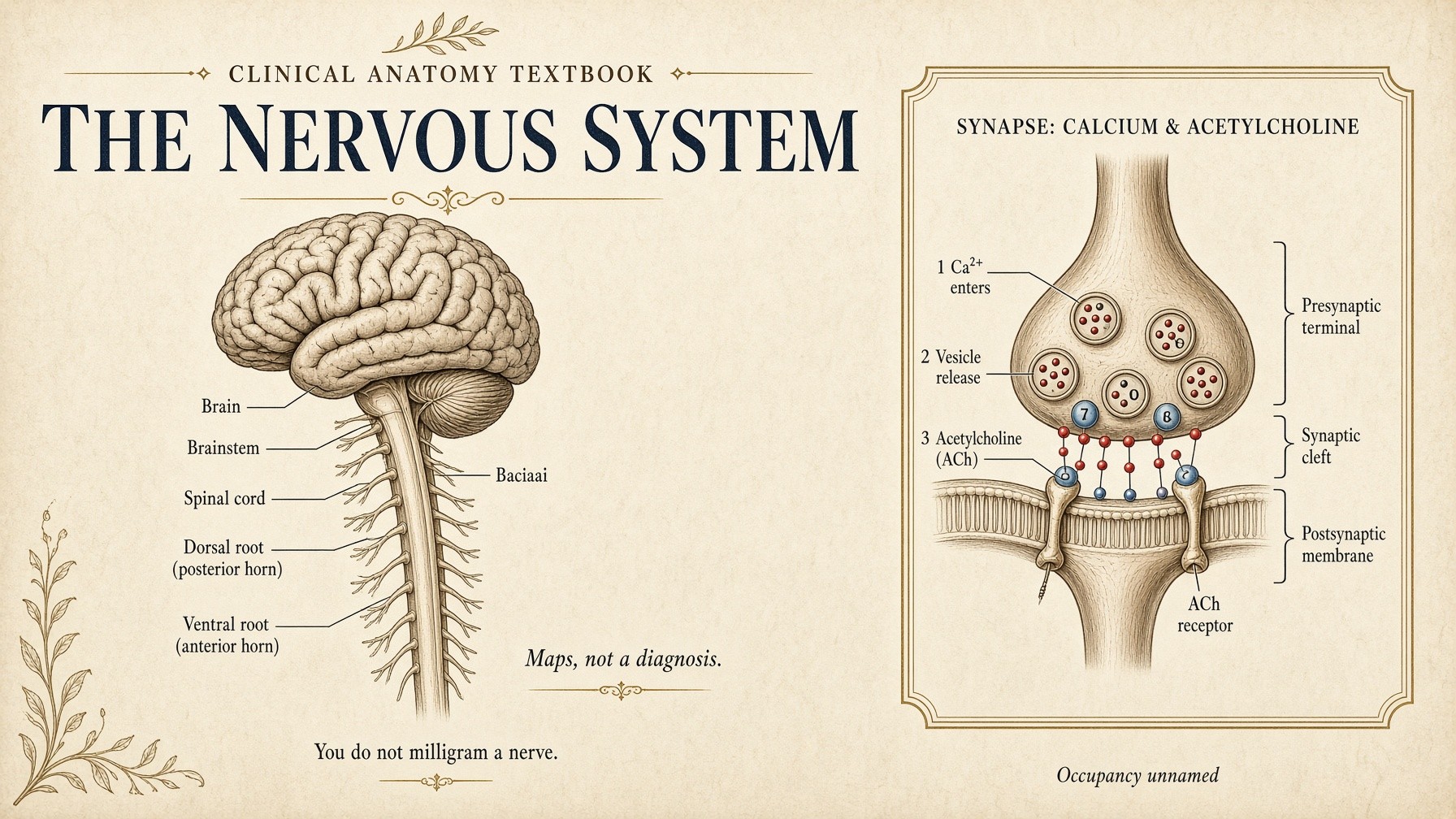
- 7. Does the signal move into the synaptic knobs? Do the knobs release the acetyl-choline? Does the acetylcholine jump across the synaptic gap to the motor end plate?
- 8. Is acetylcholine being synthesized correctly? Is there enough to sustain muscle movement?
(Check B-12, molybdenum, choline.)
- 9. Is there plentiful amounts of acetylcholine in the vesicles? If not, would a trace mineral, fatty acid, or a detoxifier be helpful?
- 10. Are the vesicles able to open up and release the acetylcholine at the bottom of the knob? (Check calcium, possibly other minerals.)
- 11. Is the fluid in the synaptic gap the right pH and the right viscosity to allow the transmitter to pass to the other side? (Check fungus, parasites, urea cycle.)
- 12. Is it being received at the receptor sites? Is it able to enter the post-synaptic membrane?
- 13. Is there enough cholinesterase to deactivate the acetylcholine at that point? (Check for
pesticides, other toxins, marijuana, heroin, etc.)
Myelin Sheath
- 14. Can we talk to your myelin sheaths?
- 15. Are they in optimal condition? (Check vaccination toxins, parasites or mycoplasma; Use Sphingolin for repairs.)
- 16. Can you synthesize adequate amounts of choline? (Check for B-12, magnesium, p-5-p, the methionine pathway, folic conversion, germanium, trace minerals, fatty acids.)
- 17. Are you willing to keep your myelin sheaths in good repair? (Check toxins, underlying belief about the need to be good and be still, past lives.)
Electrolyte Balance
- 18. Can we test your electrolyte balance along your nerve fifibers?
- 19. Show body sodium (Na+) and potassium (K+). Do you have both of these?
- 20. Do you have more of this one than you need, or more of that one? Is the proportion between these two exactly the way you want it?
- 21. Would you like to have extra of one or the other? Do you have the right amount of each one?
- 22. Now, considering that your sodium and potassium are balanced, here is calcium. Can you see it?
- 23. Do you have the right amount of calcium in your blood (or bones), in relation to the other two?
- 24. Do you want more? Would you absorb it if I gave it to you?
- 25. Is the calcium you have now in your blood in the right proportion to the magnesium? (Show it.)
Would you like more? Could you absorb it if you got it? Would Vitamin E (or magnesium) to relax the blood vessels and allow more calcium in?
How you use the lab
On yourself first, or a consenting adult. Strong holds; yield gives. If a step says stop, you stop. Walk Kapel's numbered asks in order — do not invent missing steps. When the PDF shows a sample or ingredient, hold the name and ask; this academy does not invent milligram or dosing language. Ethics still holds after the last yes.
Practice
Walk the Class 29 lab on yourself. Journal one sentence: what the body said first, and whether you stopped anywhere.
Check
This Class 29 lab is about:
- Walking Kapel's numbered asks on nervous system — permission first ✓
- Inventing a new clinical protocol
- Skipping the opening four because the PDF is long
Use the PDF sequence. Topic: nervous system.
Talk / permission in this lab is:
- How the hour is asked — not a sixth decorative step ✓
- Optional if you already know the anatomy
- A dose
Is it all right if we talk with you?
Presenting age on this hour:
- Is asked; a yield is not a lie — the field may not be in the present tense ✓
- Is ignored after Class 1
- Is a milligram of years
Are you the age you stated?
When the PDF lists ingredients or samples for nervous system, you:
- Show / hold the name and ask — literacy, not a student prescription ✓
- Write a brand and a milligram from memory
- Skip occupancy
Kapel's list stays a list of questions.
After the last clean yes:
- Ethics still holds — you do not invent more work so the hour feels complete ✓
- You must finish every number on the page
- You prescribe what was shown
Stop inventing work.
The Class 29 lab opens with:
- A favorite color, a mantra, and a crystal grid
- Name, permission to talk, alone in the auric field, and stated age — then the class asks ✓
- A milligram list you write before the first yes
Every later ask belongs on that permission. Occupancy before the trace.
A yield on permission is:
- A suggestion to press harder
- A stop ✓
- A dose you write
You do not run a meridian through a no.
“Are you all alone in your auric field?” — a yield means:
- Talk louder so the field can hear
- There is company — a cord or a split — and you do not invent chemistry yet ✓
- The person has failed the course
Company in the field is not a channel problem. Check cords and splits first.
Show / hold a name in this lab means:
- Write a milligram and a brand
- Hold the name as a question — literacy, not a dose you invent ✓
- Skip permission because the PDF listed an ingredient
Kapel's list is asked. This academy does not invent dosing language.
If a step says stop, you:
- Skip it so the lab looks complete
- Stop. The field still holds after the last yes ✓
- Press harder until you find a problem
On yourself first. Strong holds; yield gives.