
Class 27 Lab · 14 min
Ask the pump
A read of this page, with the plate.
Name. Permission. Alone in the field. Age. Then the class asks — and only then the work.
Course 27 closes in the body, not the notebook. Class 27 put the asks in order for heart, fats, circulation. Every later session still starts with name, permission, alone in the auric field, and stated age. Strong holds; yield gives. Show means hold the name — literacy, not a dose you invent.
The opening
Is this the name? Is it all right if we talk with you? Are you all alone in your auric field? Are you the age you stated? These are not small talk. A yield on permission is a stop. A yield on alone is a cord or a split — you do not run a meridian through occupied space. A yield on age is presenting age, not a lie.
The sequence
Questions for Class 27: Heart, Fats & Circulatory System
Heart
- 1. Is the heart chakra clear and open? Any cords in or out?
- 2. Is the heart meridian also owing clearly—and on the body?
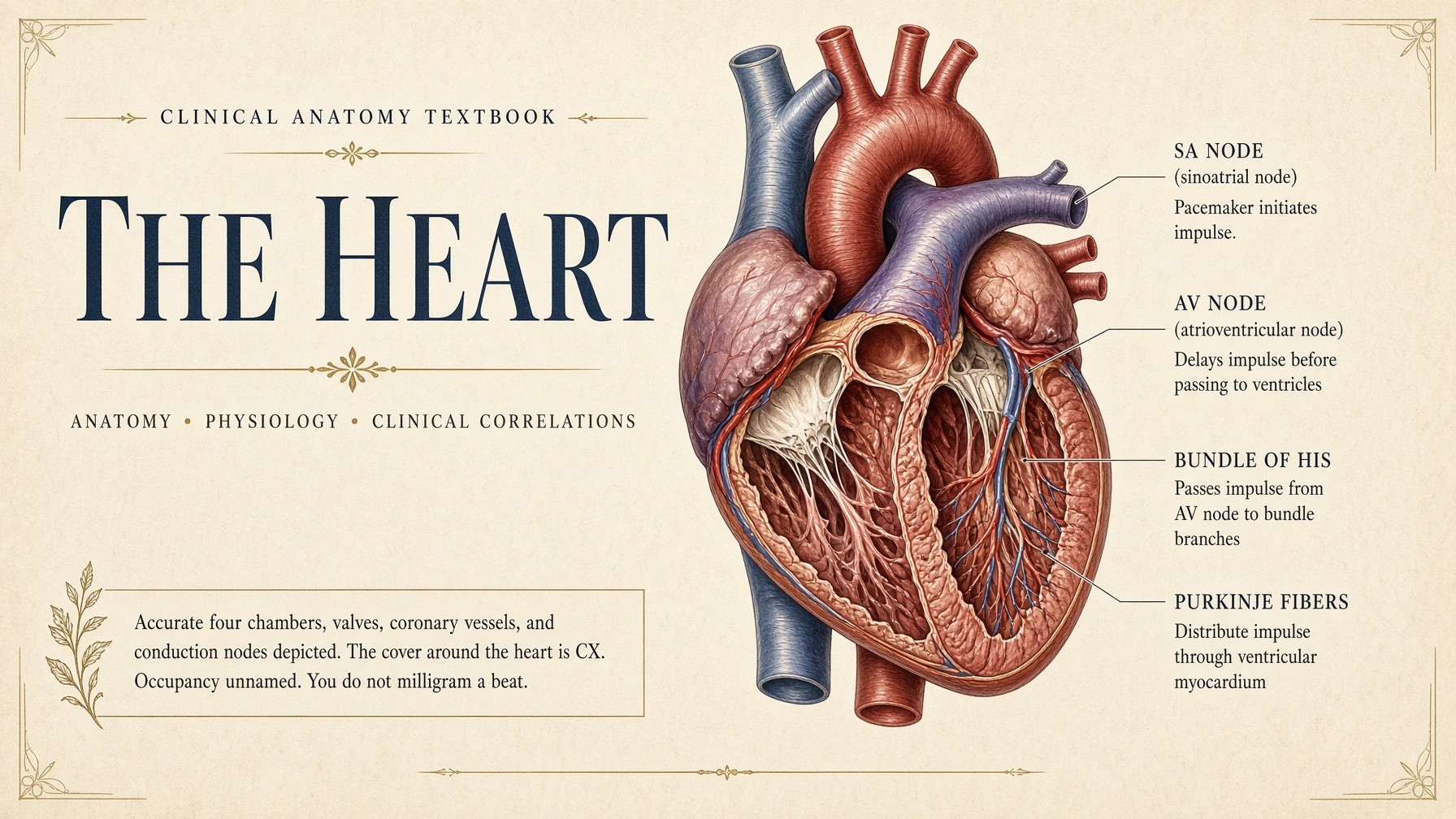
- 3. Can we talk about the way your heart pumps blood through your body?
- 4. Does the blood returning from your body ow through your superior and inferior vena cava?
- 5. Does it ow into the right atrium?
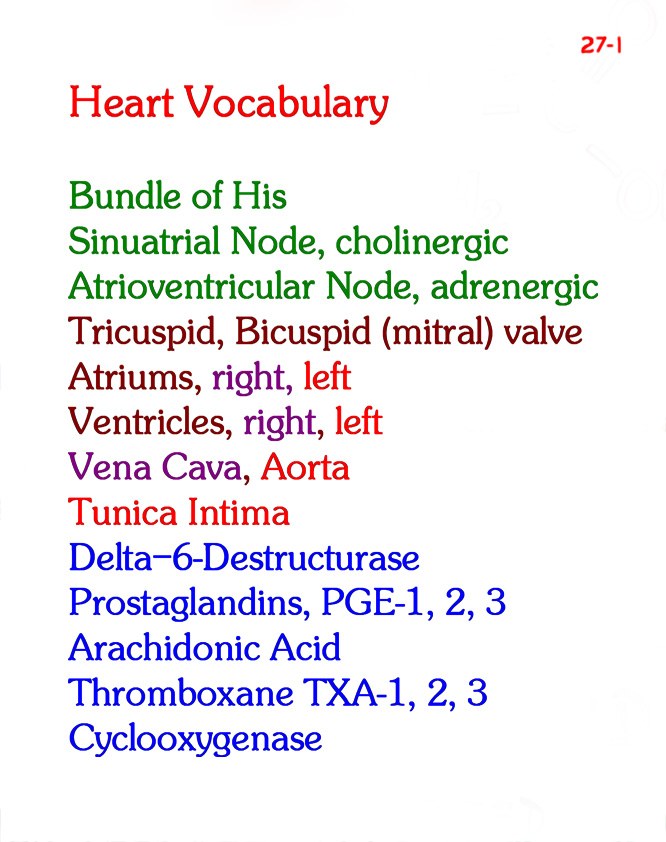
- 6. Does it pass through the tricuspid valve into the right ventricle?
- 7. Does your right ventricle pumps the blood out through the pulmonary artery into your lungs?
- 8. Do your red blood cells pick up oxygen in the lungs?
- 9. Does your oxygenated blood ow into the le atrium of your heart?
- 10. Does your le atrium pump blood past the bicuspid (mitral) valve down into the le ventricle?
- 11. Does your le ventricle pump the blood out through your aorta and to your body?
- 12. Are all your valves closing securely, completely?
- 13. Can we talk about the speed of your heartbeat?
- 14. Is your vagus nerve primarily in uencing your heart rate right now, slowing it? Is your heart bea ng at the right speed for you?
- 15. Is your sympathe c nervous system primarily in uencing your heart rate now, speeding it up? If your heartbeat is too fast, is it due to persistent catecholamines? High thyroxin? An allergy?
Veins and Arteries
- 16. Can I talk to you about your veins, the vessels that return blood to your heart?
- 17. Are they as strong and pliable as you'd like them to be?
- 18. Are your veins closing the way you'd like to prevent the blood from owing back down? (If not, see if these things would help: walking, muscle toning, improve connec ve ssue, bio avonoids, Cogni ve Nutri on and horse chestnut, collinsonia.)
- 19. Can we talk about your arteries, the vessels that carry blood away from your heart to your body?
- 20. Is your blood pressure just the way you like it?
- 21. When you have to deal with an emergency, can you increase the pressure and make the diameter of your arteries smaller? (Vasomotor control center in the medulla oblongata.)
- 22. When that emergency is over, can you then relax the arteries so they resume normal diameters? And the pressure goes back to normal? (If not, explore smoking, cadmium levels, etc.)
- 23. Do the baroreceptors in your aor c arch also help to stabilize varia ons in pressure?
- 24. Are the baroreceptor's "normal" the parasympathe c mode?
BBT Unit IV - Class 27 Heart, Fats & Circulatory System Page - 1 fl ti fl ti ft ft ti ti fl fl ti fl ti fl ft fl ti ti fl ti ti ft
- 25. Do the inside of your arteries look like this? (Give body a picture of a smooth inner surface.) Or this? (Give the body a picture such as chart 27-5, which shows damage to the inner arterial walls.)
- 26. Is there a way we can improve the biofield of your arteries? Are there some things we can do to make them even be er than they are now?
- 27. Do you see this vibra on of cysteine? (from test kit)
- 28. Did you make cysteine from cystathionine?
- 29. And with serine and P-5-P, did you make cystathionine from homocysteine? (Show it samples.)
- 30. Do you have more homocysteine circula ng in your blood than you would like?
- 31. Do you see this serine sample again? Would this help you change homocysteine to cystathionine? (If not, check for soy allergy, p-5-p [wheat allergy/methionine] and tetrahydrofolic).
- 32. Have you had too much exposure to chlorinated water? Do you need help releasing chlorine? (Test DMAE.)
- 33. Are you making cholesterol just the way you'd like to? (Silently ask "Is it s cker than you'd like?" (Inquire how to shi the error in the way the cholesterol is made.)
- 34. Do you need help relaxing the artery walls? (Check magnesium)
- 35. Do you need any of these minerals for your heart: a. Calcium to maintain heart rhythm? b. Copper to keep vessel walls strong (+bio avonoids)? c. Potassium to keep nerves responsive and prevent cramping? d. Manganese to enhance nerve conduc on? e. Selenium to scavenge for free radicals, aid oxygen u liza on
- 36. Do you need any of these (fat) xers, or an oxidants? (choline, lecithin, carni ne, inositol,
Co-Q-10, Vit. E, C, A, B3, B6, bio n, pantothenic, pangamic acid, folic, selenium, etc.)
Gallbladder
- 37. How is the energy field of your gallbladder?
- 38. Can you see if you've formed any stones? Are they made out of solidi ed cholesterol?
Bilirubin? Or calcium carbonate? (Check out lecithin, phospho
[Sequence continues in the Class PDF — walk the remaining numbered asks in order. Do not invent steps.]
How you use the lab
On yourself first, or a consenting adult. Strong holds; yield gives. If a step says stop, you stop. Walk Kapel's numbered asks in order — do not invent missing steps. When the PDF shows a sample or ingredient, hold the name and ask; this academy does not invent milligram or dosing language. Ethics still holds after the last yes.
Practice
Walk the Class 27 lab on yourself. Journal one sentence: what the body said first, and whether you stopped anywhere.
Check
This Class 27 lab is about:
- Walking Kapel's numbered asks on heart, fats, circulation — permission first ✓
- Inventing a new clinical protocol
- Skipping the opening four because the PDF is long
Use the PDF sequence. Topic: heart, fats, circulation.
Talk / permission in this lab is:
- How the hour is asked — not a sixth decorative step ✓
- Optional if you already know the anatomy
- A dose
Is it all right if we talk with you?
Presenting age on this hour:
- Is asked; a yield is not a lie — the field may not be in the present tense ✓
- Is ignored after Class 1
- Is a milligram of years
Are you the age you stated?
When the PDF lists ingredients or samples for heart, fats, circulation, you:
- Show / hold the name and ask — literacy, not a student prescription ✓
- Write a brand and a milligram from memory
- Skip occupancy
Kapel's list stays a list of questions.
After the last clean yes:
- Ethics still holds — you do not invent more work so the hour feels complete ✓
- You must finish every number on the page
- You prescribe what was shown
Stop inventing work.
The Class 27 lab opens with:
- A favorite color, a mantra, and a crystal grid
- Name, permission to talk, alone in the auric field, and stated age — then the class asks ✓
- A milligram list you write before the first yes
Every later ask belongs on that permission. Occupancy before the trace.
A yield on permission is:
- A suggestion to press harder
- A stop ✓
- A dose you write
You do not run a meridian through a no.
“Are you all alone in your auric field?” — a yield means:
- Talk louder so the field can hear
- There is company — a cord or a split — and you do not invent chemistry yet ✓
- The person has failed the course
Company in the field is not a channel problem. Check cords and splits first.
Show / hold a name in this lab means:
- Write a milligram and a brand
- Hold the name as a question — literacy, not a dose you invent ✓
- Skip permission because the PDF listed an ingredient
Kapel's list is asked. This academy does not invent dosing language.
If a step says stop, you:
- Skip it so the lab looks complete
- Stop. The field still holds after the last yes ✓
- Press harder until you find a problem
On yourself first. Strong holds; yield gives.