
Class 13 Lab · 14 min
Ask the bowel
A read of this page, with the plate.
Opening five: name, permission, alone, age, cords. Trace duodenum, jejunum, ileum. Sucrase, maltase, lactase as names. The villus finishes peptides — Class 12 already covered trypsin. Micelle, reunion, lymph. B-12 as a name. Iron gate as a picture. Colon as a frame. Stop on blood, black stool, fever, a child, dehydration, a polyp. Parasites next week. Thank the field.
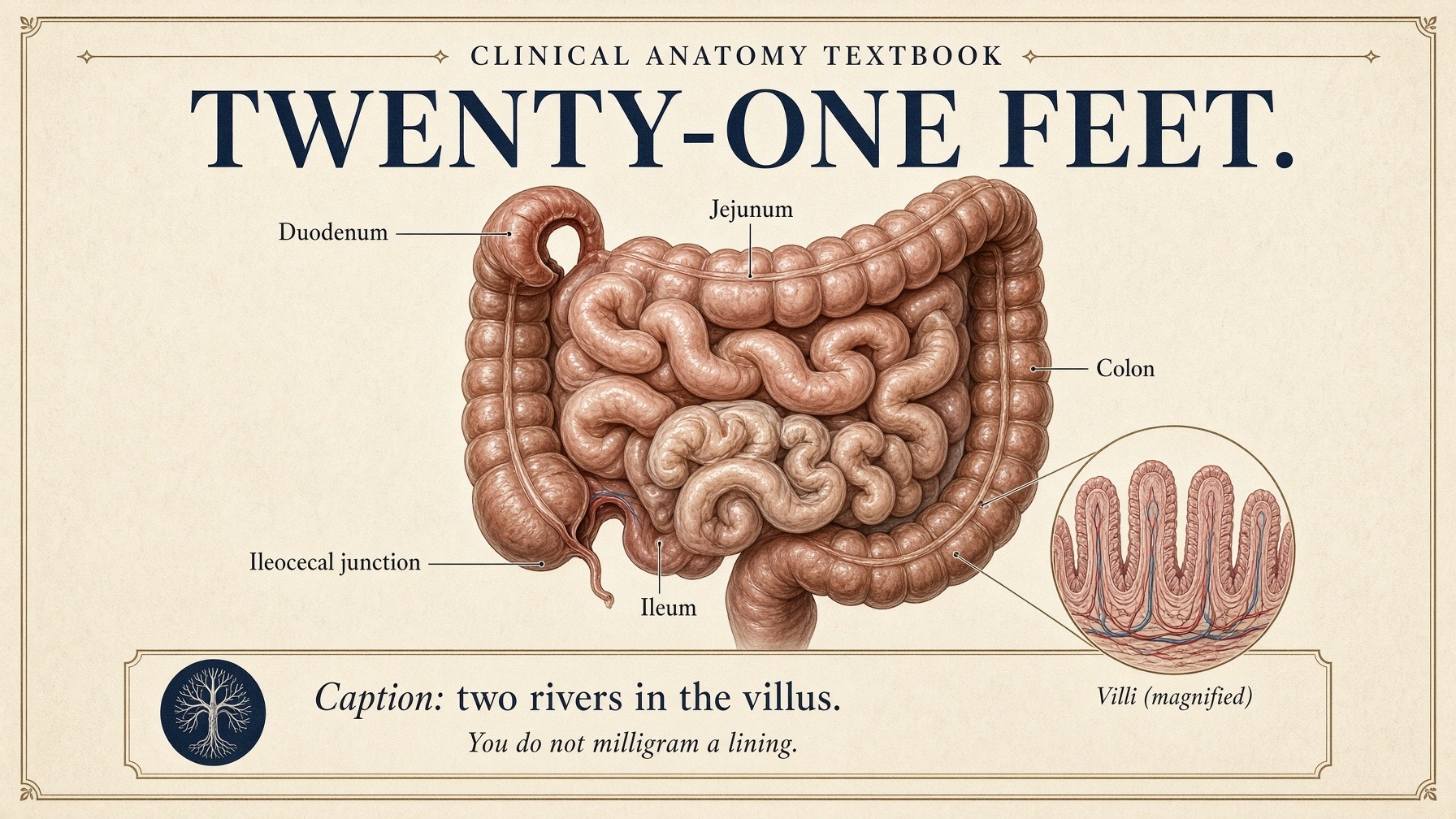
Course 13 closes in the body, not the notebook. Class 13 put the asks in order for intestines. Every later session still starts with name, permission, alone in the auric field, and stated age. Strong holds; yield gives. Show means hold the name — literacy, not a dose you invent.
The opening
Is this the name? Is it all right if we talk with you? Are you all alone in your auric field? Are you the age you stated? These are not small talk. A yield on permission is a stop. A yield on alone is a cord or a split — you do not run a meridian through occupied space. A yield on age is presenting age, not a lie.
The sequence
Initial Question
- 1. Is this (client's name)?
- 2. Is it all right if we work with you today?
- 3. Is anyone else in your auric ield other than you?
- 4. Are you (client's age) years old?
Questions for Small Intestine Touch the SI and ask…
Is the bio ield just the way you'd like it to be in: the duodenum? The jejunum? The ileum? Trace these areas with your hand.
- 1. Carbohydrates: Small Intestine, can you tell us what you do with them?
a. Do you have the sucrase to divide the disaccharide sucrose into the mono- saccharides glucose and fructose?
If not, ask about a sugar allergy
b. Do you have the maltase to divide the other dichaccharides?
If not, you can skip this. If you want to make some discoveries, ask the body what foods maltase works with.
c. Do you have the lactase to divide lactose into glucose and galactose?
If not, ask about milk allergy.
- 2. Proteins: Can you tell us what you do with proteins?
a. Do you have the peptidase to break the di- and tri-peptide chains down to single amino acids, with the enzyme peptidase?
If this enzyme is not available, you need to ind out how to help your friend have access to it. When you come to something that you don't
know, you need to ask the body-consciousness three questions:
f s
f f
- 1. Is there a toxin blocking the synthesis or the availability of that enzyme?
(If so, check the detox box.)
- 2. Is there a nutrient you need in order to make it? (If so, ind out if it needs a mineral, a B vitamin, an oil soluble vitamin, or a fatty acid. )
It is also true that the body will say "yes I need it," because it needs to have it in order to do what you have asked about---but it might already have that nutrient available---it might have just been telling you what it needs to do the process.
In that case you wouldn't have to supply it, even though from your testing the body appeared to ask for it. This is why supplement suggestions need to be done carefully, in view of what supplements your friend is already taking, or receiving from food.
You can practice determining the dosage. Supplements will come up, and they will be useful certainly---but this is mostly a way to ind out how to make an INQUIRY.
- 3. Is there an emotional reason for blocking this enzyme? If so you may not want to deal with it right now, but it would be an issue around fear, anger, grief, sympathy, self-blame, or some variation of these categories.
b. Do the amino acids slide into the villi, and enter the capillaries? If not, ask about gluten allergy, or a mycoplasmic cover-up.
c. Are the villi of the SI in perfect condition? Any bent villi? Any that are shrunk?
If so, check for gluten allergy. Mycoplasma doesn't bend the villi.
- 3. Fats and oils: small intestine, can you tell us what you do with fats and oils?
a. Are the oil soluble vitamins being absorbed? If not, do you get enough fats in your diet to absorb these vitamins?
f f
b. If yes, your friend gets enough fats, so is there a problem with fat digestion? If yes, ask if bile is being synthesized and received by the gall bladder.
Then, ask if the duodenum is receiving CCK, to empty the gall bladder.
Then ask if the pancreatic lipase is breaking the ester linkage and freeing the fatty acids up for transport by the micelles.
c. Is the bile forming micelles, to transport the free fatty acid chains?
(it will)
d. Can the micelles enter into the villi's membrane? If not, ask if this is due to a gluten allergy or a mycoplasmic ilm.
e. If they do get into the villi, do the fatty acid chains bond with the glycerol backbone to form triglycerides once again?
(they will)
f. Are the triglycerides being converted into chylomicrons in the epithelial cells of the SI?
(they will)
g. Do the chylomicrons pass into the lymph capillaries inside the SI's villi?
If not, is there something interfering with the receptor sites?
h. Are the chylomicrons being transported by the lymph system, to join with the bloodstream in the heart?
(They will)
- 2. Hold your hand over lower right abdomen, the ileum, while holding B12.
Ask "Ileum, are you allowing the B12 to be absorbed into the bloodstream?" If not, is there an emotional reason why you don't want to receive B-12? Let this go, for now, we'll take that up during the allergy class.
- 3. Is iron being absorbed in exactly the right amount, in the Ileum?
Put Iron and Rubidium and Selenium on the body. Do you have these minerals available?
- 4. Is the iron gate working perfectly?
f
Next, ask about the positions of the selenium and rubidium.
- 5. Depending on the needs of the body, are these minerals placed correctly?
Is the rubidium (Rb) next to the nutrient surface, to invite the iron in? Then the selenium (Se) will be on the other side of the access pore, at the capillary surface.
Is the selenium next to the nutrient surface, to keep the iron out? Then the rubidium goes over to the capillary surface.
Questions about the Colon
- 1. To trace the bio ield of the colon: Start with your hand over low right abdomen,
Check the bio ield of the ascending colon, hepatic lexure, the transverse colon, the splenic lexure, the descending colon, the sigmoid lexure, the sigmoid colon, and inally the rectum. You have now done a vibrational colonoscopy!
- 2. If you found an area where the bio ield was low,
Are t
[Sequence continues in the Class PDF — walk the remaining numbered asks in order. Do not invent steps.]
How you use the lab
On yourself first, or a consenting adult. Strong holds; yield gives. If a step says stop, you stop. Walk Kapel's numbered asks in order — do not invent missing steps. When the PDF shows a sample or ingredient, hold the name and ask; this academy does not invent milligram or dosing language. Ethics still holds after the last yes.
Practice
Walk the Class 13 lab on yourself. Journal one sentence: what the body said first, and whether you stopped anywhere.
Check
This Class 13 lab is about:
- Walking Kapel's numbered asks on intestines — permission first ✓
- Inventing a new clinical protocol
- Skipping the opening four because the PDF is long
Use the PDF sequence. Topic: intestines.
Talk / permission in this lab is:
- How the hour is asked — not a sixth decorative step ✓
- Optional if you already know the anatomy
- A dose
Is it all right if we talk with you?
Presenting age on this hour:
- Is asked; a yield is not a lie — the field may not be in the present tense ✓
- Is ignored after Class 1
- Is a milligram of years
Are you the age you stated?
When the PDF lists ingredients or samples for intestines, you:
- Show / hold the name and ask — literacy, not a student prescription ✓
- Write a brand and a milligram from memory
- Skip occupancy
Kapel's list stays a list of questions.
After the last clean yes:
- Ethics still holds — you do not invent more work so the hour feels complete ✓
- You must finish every number on the page
- You prescribe what was shown
Stop inventing work.
The Class 13 lab opens with:
- A favorite color, a mantra, and a crystal grid
- Name, permission to talk, alone in the auric field, and stated age — then the class asks ✓
- A milligram list you write before the first yes
Every later ask belongs on that permission. Occupancy before the trace.
A yield on permission is:
- A suggestion to press harder
- A stop ✓
- A dose you write
You do not run a meridian through a no.
“Are you all alone in your auric field?” — a yield means:
- Talk louder so the field can hear
- There is company — a cord or a split — and you do not invent chemistry yet ✓
- The person has failed the course
Company in the field is not a channel problem. Check cords and splits first.
Show / hold a name in this lab means:
- Write a milligram and a brand
- Hold the name as a question — literacy, not a dose you invent ✓
- Skip permission because the PDF listed an ingredient
Kapel's list is asked. This academy does not invent dosing language.
If a step says stop, you:
- Skip it so the lab looks complete
- Stop. The field still holds after the last yes ✓
- Press harder until you find a problem
On yourself first. Strong holds; yield gives.