
Charts 4-1 · 4-2 · 12 min
The glossary, revised
A read of this page, with the plate.
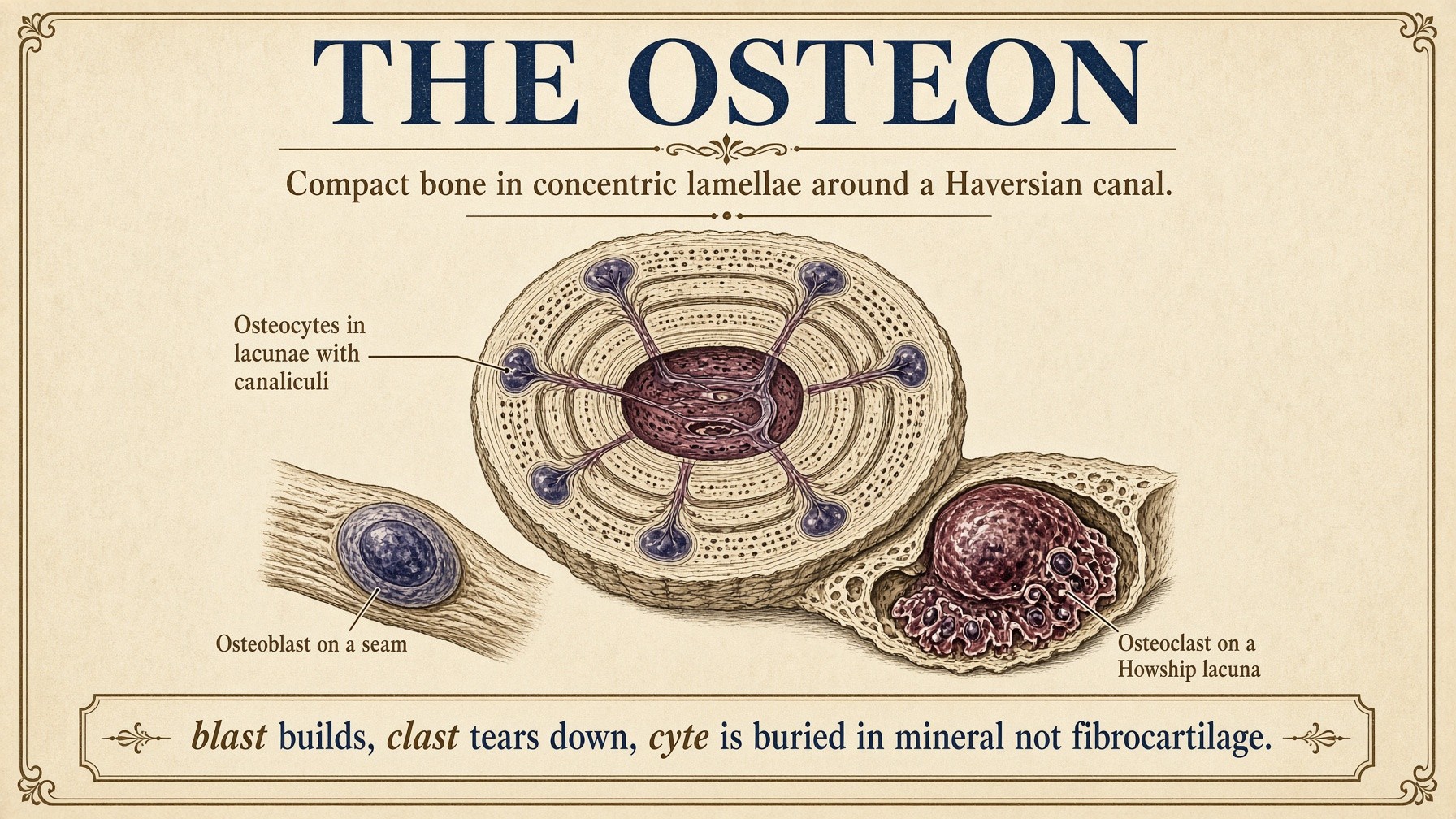
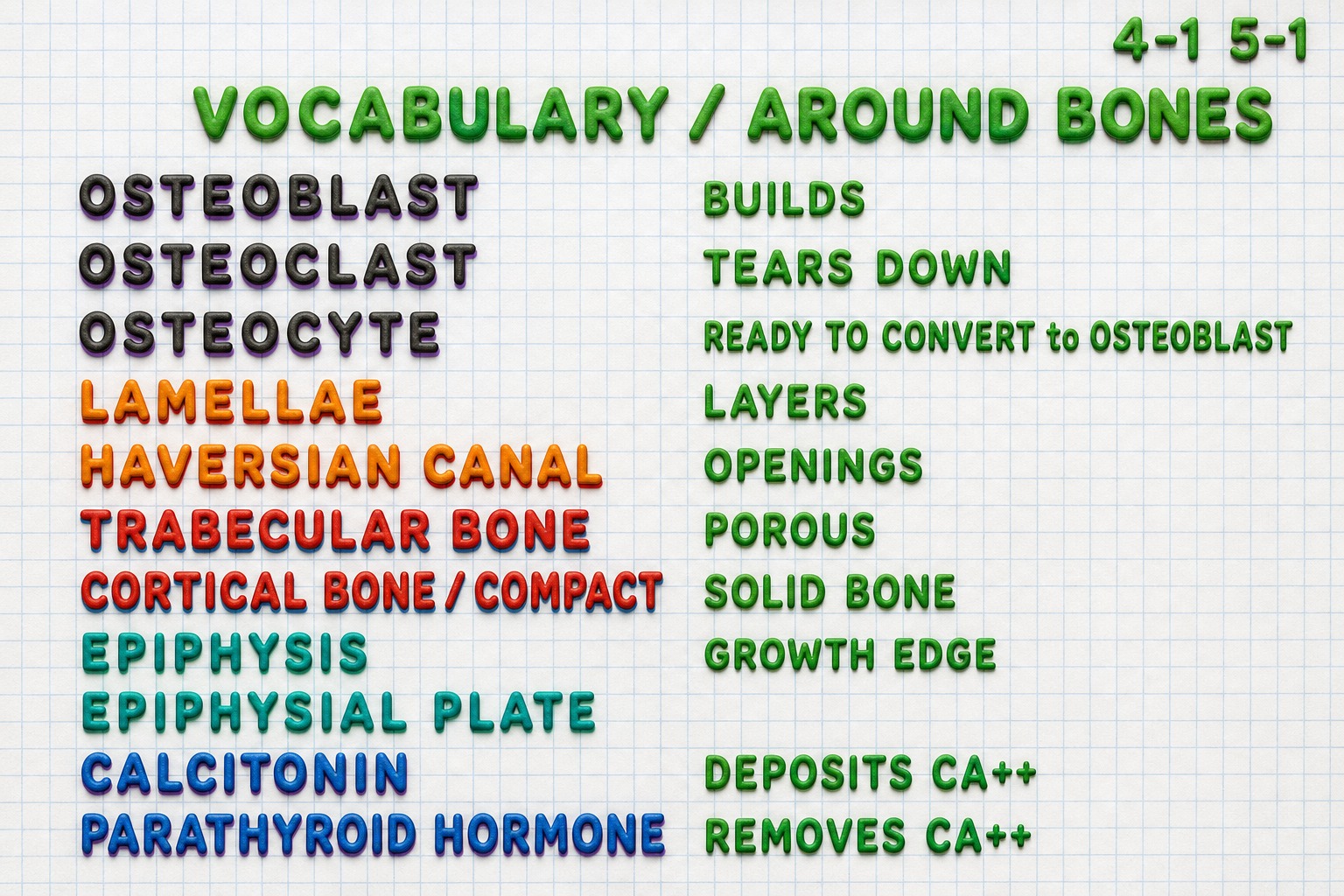
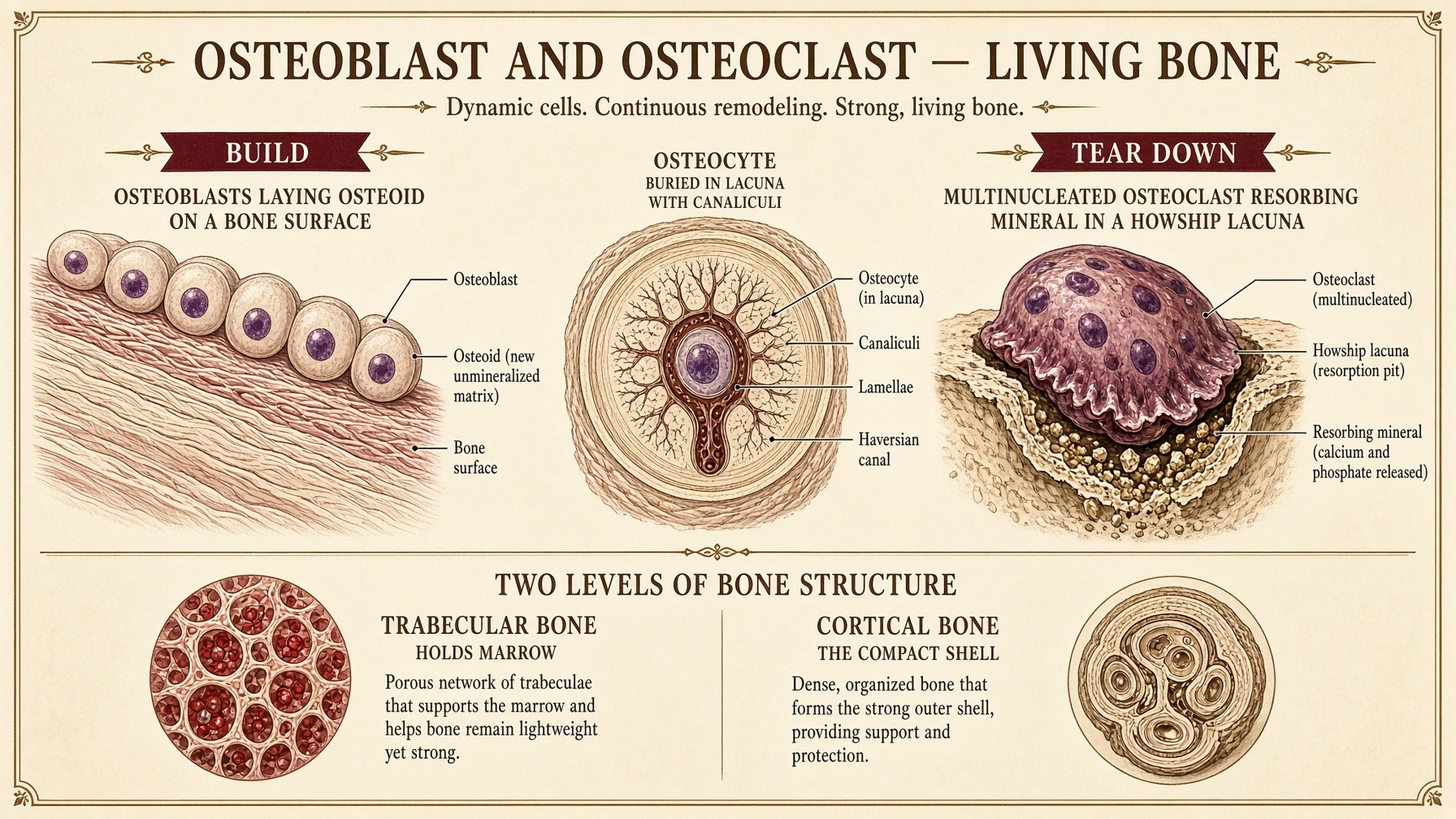
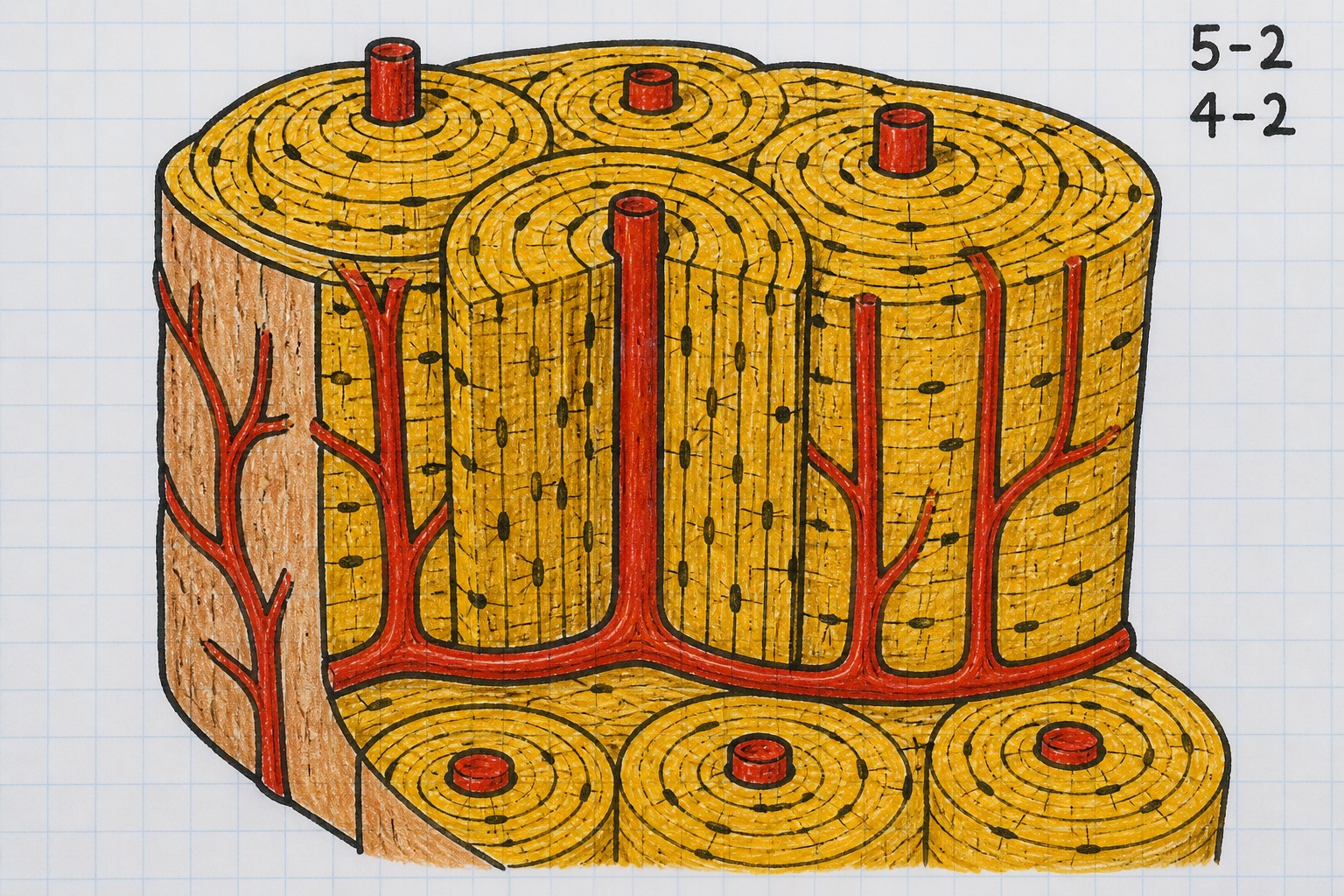
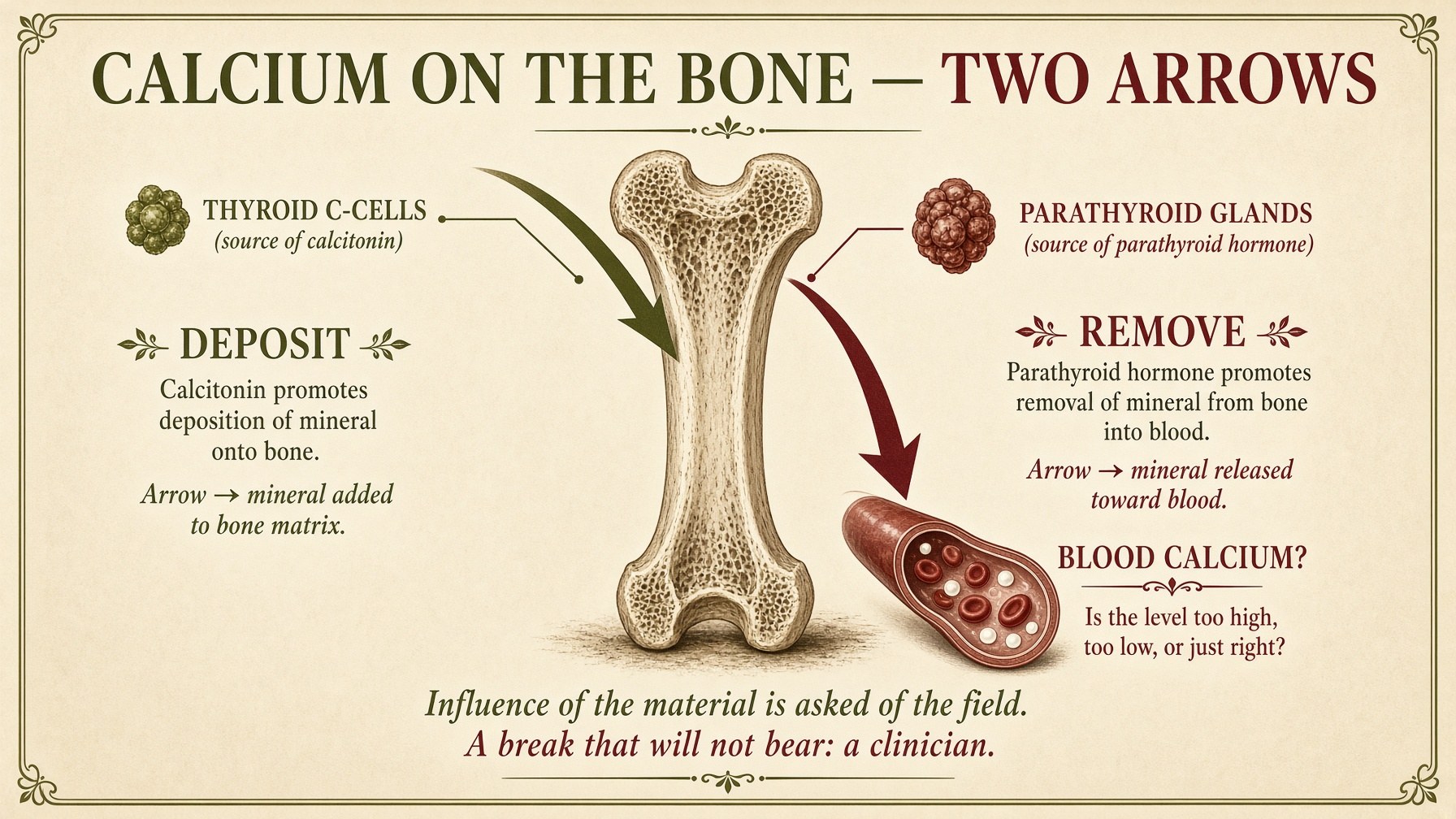
Osteoblast builds. Osteoclast tears down. Osteocyte is the buried neighbor. Lamellae are layers. A Haversian canal is the opening a capillary uses. Trabecular bone is porous and holds marrow. Cortical bone is the compact shell. Epiphysis is the end of a long bone. Calcitonin and parathyroid hormone are the two arrows on her board: deposit, remove.
The landings that keep Chart 1-1 honest
The board says the osteocyte is buried in fibrocartilage and ‘ready to convert to osteoblast.’ An osteocyte lives in mineralized osteoid, in a lacuna, talking through canaliculi. Fibrocartilage is a fracture-callus word, not the everyday matrix. Calcitonin comes from parafollicular C cells of the thyroid; its main job in us is to quiet osteoclasts, not to personally escort calcium into a blast. The epiphyseal plate is hyaline cartilage that lengthens a bone; when it closes it becomes a line. Kapel wrote that a fully calcified epiphysis forms the plate. The sequence is the other way.
Fluoride on 4-2
Excess fluoride is named as unkind to bone. Here that stands as emotional influence of the material. You ask. Chart 1-1 still orders the work if a feeling belongs on the chip.
Her voice, from the class.
Osteoblast / osteoclast / osteocyte — the vocab
Practice
Open each cell in the glossary. Say Kapel’s line, then the line that stands. Ask fluoride once as influence.
Check
An osteocyte, in the line that stands, lives:
- In mineralized osteoid, in a lacuna, connected by canaliculi ✓
- In fibrocartilage, ready to become an osteoblast on command
- In the thyroid, next to calcitonin, as a C cell
The fibrocartilage burial does not stand. Mineralized bone. Lacuna. C cells make calcitonin.
You use the glossary by:
- Keeping the plate as hyaline that becomes a line, C cells as calcitonin, and fluoride as influence ✓
- Parking the osteocyte on gallbladder so the burial has a meridian
- Collapsing PTH and calcitonin into one kidney door, with iliopsoas
Plate, then line. C cells. Influence. GB is tendon-and-bone as address, not a cell. Kidney is iliopsoas.
Cyte is buried on this hour:
- Squeezing the gate until it 'opens'
- In mineral, not in fibrocartilage ✓
- A rigid medical diagnosis you must stamp
Cyte is buried — In mineral, not in fibrocartilage
The epiphyseal plate on this board:
- Living against the tide on purpose
- Hyaline cartilage that lengthens a bone; when it closes it becomes a line ✓
- A cream you prescribe from the chart
The epiphyseal plate — Hyaline cartilage that lengthens a bone; when it closes it becomes a…
A true line on this hour:
- A swap of clothes for the organ
- Osteocyte is the buried neighbor. ✓
- Opening a chakra by squeezing it
Osteocyte is the buried neighbor.
The glossary, revised — keep this:
- A bottle that finishes the feeling
- Trabecular bone is porous and holds marrow. ✓
- A dose you write from a yield
Trabecular bone is porous and holds marrow.
This hour teaches that:
- A name that captures the whole sky
- Cortical bone is the compact shell. ✓
- A board you invent without her permission
Cortical bone is the compact shell.
Practice on this hour is to:
- Thyroxine from the medulla
- Open each cell in the glossary. ✓
- Prescribe so the quiet looks finished
Method before bottle. Trace what the lesson names.
Chart 4-1 on this hour is used as:
- Inventing a colorful story so the session feels complete
- Blast builds. Clast tears down. Cyte is buried — in mineral, not in fibrocartilage. ✓
- A reason to skip permission
Translator map — Chart 4-1. Not a prescription pad.
The lab on this hour is for:
- A graded exam that invents the next curriculum
- Feeling and naming what the lesson maps — journal, not a bottle ✓
- A prescription pad for the lab name
Lab is literacy. Not a dose from the yield.