
Class 16 Lab · 14 min
Ask the food, tell the person
A read of this page, with the plate.
Permission. Is it OK to eat this food. One door. Age, story, feeling, meridians, retest. Hay fever if there is time. Ask if this is a good place to stop.
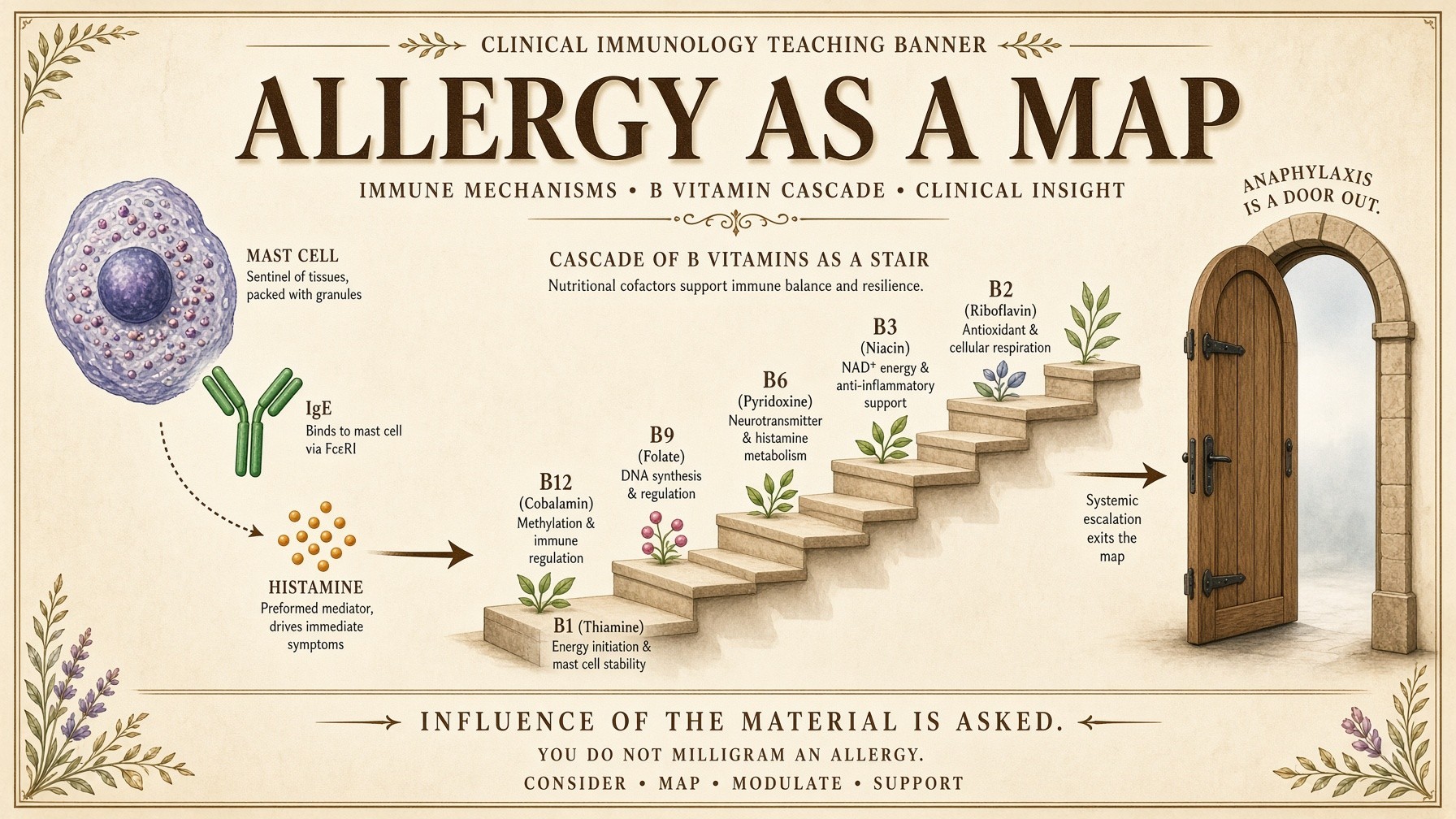
Course 16 closes in the body, not the notebook. Class 16 put the asks in order for allergy II. Every later session still starts with name, permission, alone in the auric field, and stated age. Strong holds; yield gives. Show means hold the name — literacy, not a dose you invent.
The opening
Is this the name? Is it all right if we talk with you? Are you all alone in your auric field? Are you the age you stated? These are not small talk. A yield on permission is a stop. A yield on alone is a cord or a split — you do not run a meridian through occupied space. A yield on age is presenting age, not a lie.
The sequence
Class 16: Allergy II Practice Session May 11, 2016
- 1. Calibrate the client: Name? Age? Anybody in your field?
- 2. Do you have allergies you'd like to talk about?
You might not have time to cover all of these allergy topics. Good idea to start with foods, go through that, and if you can resolve those easily or find that they are not a problem, and have time for the rest, then continue to pollens, and then plastics and petroleum. (Don't try to do everything, or we'll be here until 1:00 tonight!)
A. Questions for Allergies, Starting with foods
Talk to the client directly: Do you have any food allergies that you are aware of? Do you know what they are? If the client doesn't know, or doesn't think so, ask this:
Is it OK to test a few foods anyway? We might find out that there are some you were not aware of.
When you show the food sample, say
Is it OK to eat this food? (Not "do you like it" or "do you want it" or "How about this food, it this OK for you"?) The issue is about eating it!
Ask about Corn, Rice, Oats, Beans, Potato, and Sugar
Corn allergy causes tendon weakness by blocking the uptake of lysine and the synthesis of proline, and also constricts tubes and ducts. Associated with lysine and proline.
Rice allergy causes cold hands and feet, constricts circulation, and is associated with incorrect cascade of isoleucine, and sometimes valine, if the client reports there is some itchy or crawly-feelings in the skin.
Oat allergy diminishes the synthesis of GABA and Proline, which are both derived from glutamate, by blocking the transition from glutamine to glutamate.
Bean allergy is associated with dyslexia, but I don't know the amino acid relationship.
Potato allergy creates a tryptophan dysfunction in a part of the cascade that has nothing to do with milk allergy---and this causes an alanine utilization disorder. Alanine would not be able to help the body synthesize glycogen, for storing glucose in the liver.
Sugar allergy comes up as a result of a sucrase shortage, when the small intestine is not functioning well. The sucrose isn't able to divide into glucose and fructose, so it goes through as a disaccharide, causing brain changes, and hyperactivity.
If one of your food samples shows up as weak, turn to the client, and ask if there is a negative emotional association with that particular food. (She will say yes.) If there are others, ask her which one she wants to work on.
Then pick one that she selected, locate the age when the allergy was initiated, and figure out the situation together, identify the feelings, locate meridians, and run them.
Next ask if there was another time when this allergy was reinforced. If so, find that age, figure out the situation, identify the feelings, and run the meridians.
You will not have time to process all the foods she flagged during this practice time. You might want to let go of that, and move toward questions about hay fever and histamine reactions. The method of identification and release is the same.
B. Pollens, Animals, Dust, Insect Bites and Stings These allergies are histamine related, causing eyes and nose congestion itching, hives, swelling, the classic symptoms we associate with allergy. Show her histidine, and explain that it makes histamine, and this is what causes the symptoms she has been experiencing. Start out by asking the client: Look at the client and ask!. And then listen!
Do you have hay fever, or pollen or "seasonal" allergies?
Do you have cat or dog allergies?
Do you have strong reactions to insect bites or stings?
How does dust affect you? Let her talk about that for a minute.
Which one of these would you like to work on this evening?
Whatever she selects,
Now picture the flowers, (weeds, or the animals) you react to. Do you think it was really the weed, or the animal, or is your response symbolic of something else?
It is a pun? Explore that together.
Once you figure that out, proceed toward releasing it.
I will ask your body-consciousness to tell us when this sensitivity fifirst started. Let's locate the age. Turn to her and ask her to tell you what happened at that time, and listen to her story. Find out what the feeling is, locate the meridians, and run them.
When you are finished, ask if this is a good place to stop.
If you want to work with fuel fume and plastic allergies you can if you have time, but basically you have practiced the process by now, and it applies to all the other allergies that you will run across.
At this point you are really doing Bioenergy Balancing! Congratulations!
This is the end of our unit, and the next one will be about endocrines, kidneys, and other interesting things. Have a wonderful time!
How you use the lab
On yourself first, or a consenting adult. Strong holds; yield gives. If a step says stop, you stop. Walk Kapel's numbered asks in order — do not invent missing steps. When the PDF shows a sample or ingredient, hold the name and ask; this academy does not invent milligram or dosing language. Ethics still holds after the last yes.
Practice
Walk the Class 16 lab on yourself. Journal one sentence: what the body said first, and whether you stopped anywhere.
Check
This Class 16 lab is about:
- Walking Kapel's numbered asks on allergy II — permission first ✓
- Inventing a new clinical protocol
- Skipping the opening four because the PDF is long
Use the PDF sequence. Topic: allergy II.
Talk / permission in this lab is:
- How the hour is asked — not a sixth decorative step ✓
- Optional if you already know the anatomy
- A dose
Is it all right if we talk with you?
Presenting age on this hour:
- Is asked; a yield is not a lie — the field may not be in the present tense ✓
- Is ignored after Class 1
- Is a milligram of years
Are you the age you stated?
When the PDF lists ingredients or samples for allergy II, you:
- Show / hold the name and ask — literacy, not a student prescription ✓
- Write a brand and a milligram from memory
- Skip occupancy
Kapel's list stays a list of questions.
After the last clean yes:
- Ethics still holds — you do not invent more work so the hour feels complete ✓
- You must finish every number on the page
- You prescribe what was shown
Stop inventing work.
The Class 16 lab opens with:
- A favorite color, a mantra, and a crystal grid
- Name, permission to talk, alone in the auric field, and stated age — then the class asks ✓
- A milligram list you write before the first yes
Every later ask belongs on that permission. Occupancy before the trace.
A yield on permission is:
- A suggestion to press harder
- A stop ✓
- A dose you write
You do not run a meridian through a no.
“Are you all alone in your auric field?” — a yield means:
- Talk louder so the field can hear
- There is company — a cord or a split — and you do not invent chemistry yet ✓
- The person has failed the course
Company in the field is not a channel problem. Check cords and splits first.
Show / hold a name in this lab means:
- Write a milligram and a brand
- Hold the name as a question — literacy, not a dose you invent ✓
- Skip permission because the PDF listed an ingredient
Kapel's list is asked. This academy does not invent dosing language.
If a step says stop, you:
- Skip it so the lab looks complete
- Stop. The field still holds after the last yes ✓
- Press harder until you find a problem
On yourself first. Strong holds; yield gives.